Quick Answer
A speeding ticket does not automatically prove you caused a collision. It shows a police officer believed you broke a traffic law, but fault is a separate legal question. Insurers and courts look at the full picture: road conditions, witness accounts, vehicle data, and each driver’s actions. A ticket can be strong evidence of negligence, yet the other driver may still carry most or all of the blame.
Introduction
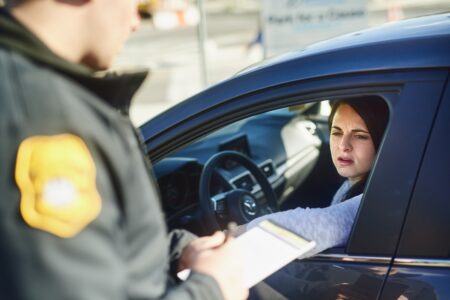
Picture flashing lights in your mirror moments after a crash, then a ticket pressed into your hand for going a little over the limit. It feels like a verdict handed down on the spot. Does that slip of paper mean the whole accident was your doing? Often, it does not.
Plenty of drivers assume a citation seals their fate, when the truth sits much deeper. If you were injured in a collision and want to understand where you truly stand, start by separating the traffic charge from the question of who is legally responsible. These are two different systems with two different standards of proof, and mixing them up can cost you real money.
A ticket is one clue among many. Vehicle damage, road conditions, witness statements, and the other driver’s behaviour all shape the final answer. Once you see how these pieces connect, you are in a far stronger position to protect your rights and pursue any compensation you may be owed.
Traffic Citation Versus Legal Liability: Two Separate Questions
A citation and a finding of fault come from two separate processes. When an officer writes you up for speeding, they are enforcing traffic law based on what they saw or measured at the roadside. Whether that speed actually caused the crash gets answered later, by insurance adjusters or a court weighing civil responsibility. One process asks whether you broke a rule. The other asks who is responsible for the damage.
That gap is exactly why the question of does a speeding ticket prove fault in an accident rarely comes down to a clean yes or no. A driver can be ticketed and still recover money for their injuries. Another can dodge a citation completely and still be found mostly to blame once every piece of evidence is on the table.
What Police Note Versus What Adjusters Weigh
The person handing you a ticket and the person deciding your claim are hunting for different things:
- Police at the scene focus on observable violations, statements, and immediate signs of a broken traffic law.
- Insurance adjusters trace the sequence of events, each driver’s duty of care, and how much each one contributed.
- Courts apply the legal test for negligence, asking whether the violation was a genuine cause of the harm.
When Speed Actually Causes the Crash
Speed only assigns blame when it truly played a part in the collision. Compare a few everyday situations:
| Scenario | Likely Fault Outcome |
| You go 10 km/h over and a driver runs a red light into your path | The other driver likely bears most fault; their violation caused the crash |
| You speed heavily and rear-end a stopped vehicle | Your speed is a direct factor, so you carry the larger share |
| You are cited for expired registration after being hit | The paperwork issue has no bearing on who caused the wreck |
The pattern is clear. A ticket tied to the real cause of impact carries weight, while one for an unrelated infraction rarely moves the needle on liability.
How Negligence Shapes the Outcome
Canadian collision claims rest on negligence, meaning a driver failed to take reasonable care and that failure led to harm. Breaking a safety law, like a posted limit, can support the argument that a driver acted carelessly. The injured person still has to connect that carelessness to the damage they suffered. A ticket helps build that bridge, but it does not finish the walk across on its own.
Knowing who caused the crash is only half the story, because blame rarely rests on one set of shoulders alone.
Using a Traffic Ticket as Evidence in a Car Accident Case
Once fault is in dispute, evidence decides the outcome. A ticket is only one entry in a much larger file, and the driver who gathers the strongest proof usually comes out ahead. The matter of speeding ticket after car accident who is at fault gets settled here, through careful documentation, not on the roadside.
Proof That Carries Real Weight
Several sources can confirm or challenge what a citation suggests:
- Event data recorders, often called a vehicle’s black box, log speed, braking, and steering in the seconds before impact.
- Police reports capture the officer’s observations, diagrams, and any statements made at the scene.
- Photos and dashcam footage preserve road conditions, signage, skid marks, and vehicle positions.
- Witness accounts offer a neutral view of how events unfolded.
- Medical records tie your injuries directly to the crash.
Any one of these can shift the picture. Black box data, for example, might show the other driver was travelling far faster than they claimed, turning a traffic ticket as evidence in a car accident case in your favour rather than against you.
When Both Drivers Share the Blame
Most Canadian provinces split responsibility by percentage. Say you were going slightly over the limit while the other driver turned across your lane. A court might assign you 25 percent and them 75 percent, and you would still recover, just reduced by your share. That principle answers whether does a traffic citation determine liability all on its own: it does not, because fault can be divided among everyone involved.
Practical Steps to Protect Your Claim
A few simple moves strengthen your position after any crash:
- Request copies of the police report, the ticket, and any photos taken.
- Write down your own account while the details are fresh.
- Keep records of every medical visit and expense.
- Avoid admitting blame to anyone at the scene.
Handled well, an at fault accident with speeding ticket insurance dispute can still end in fair compensation. What you do in the first few days often shapes the result more than the citation ever will.
What the Ticket Really Means for Your Claim
A speeding ticket is a starting point, not a final verdict. It signals that an officer believed a traffic law was broken, yet responsibility for a collision gets decided through a separate lens that weighs cause, care, and consequence. One driver can hold a citation and still recover fairly. Another who was never ticketed may end up carrying the larger share of blame.
What truly shapes the outcome is evidence: vehicle data, witness accounts, photos, and medical records that show how the crash unfolded. Gather these early, stay measured in what you say, and keep clear records. Do that, and a single slip of paper loses much of its power to define your future. The full story, not the ticket alone, decides who pays.