
Parking lots feel less formal than streets. Cars move slowly, painted arrows are sometimes faded, and pedestrians cross wherever the shortest route takes them. The absence of traffic lights does not make an injury there legally simple.
When a vehicle strikes someone outside a store, attention usually turns to the driver. The owner of the lot enters the picture for a different reason: something about the property itself contributed. A traffic citation does not establish that the lot was safe, and an accident on private property does not make its owner responsible for the driver.
Begin With the Vehicle, Not the Address
The first issue is what the vehicle was doing immediately before contact. These cases often involve a driver reversing from a space, turning through a pedestrian route or leaving a drive-through while watching traffic from only one direction.
Creeping through a parking lot is still driving. A backup camera shows the area behind the bumper, but someone approaching from the side can remain outside the image until the last moment.
Kansas City addresses pedestrian safety in Article IX of Chapter 70. Drivers must use due care around pedestrians and yield when crossing a sidewalk. Inside a private lot, the exact traffic charge depends on where the incident occurred; a painted walkway does not necessarily have the same legal status as a public-street crosswalk.
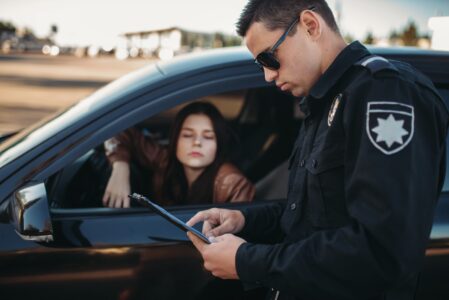
The citation records the responding officer’s assessment, formed from statements, damage, injuries and available video. Civil fault receives a broader review and is not decided by the box checked on the ticket.
Premises Liability Needs More Than an Accident on the Premises
The property claim begins with a condition in the lot, not with the mere fact that the lot has an owner.
Poor lighting, damaged pavement and landscaping that blocks a crossing deserve attention when they direct pedestrians into traffic or keep drivers from seeing them. The relevant party could be the owner, a property manager, a tenant or a maintenance contractor. Lease terms often reveal who controlled the area.
Notice comes next. A light that failed shortly before an incident presents a different record from one left dark despite repeated complaints. Premises liability rests on proof that the responsible party knew, or should have known, about the danger and failed to address it.
A recent Missouri case shows how demanding that connection is. In Simmons v. Keat Properties, an SUV moved from a nose-in space through a café storefront. The injured parties pursued the motorist and the businesses connected to the property.
The Missouri Court of Appeals did not treat nose-in parking facing a storefront as inherently dangerous. One similar incident ten years earlier was too isolated and remote to make another incursion sufficiently foreseeable. Without proof of a dangerous property condition or a reason to anticipate the driver’s conduct, the claims against the property defendants failed.
Rows facing a building, busy customer turnover or the theoretical benefit of barriers do not establish premises liability on their own. Evidence must connect a condition under the defendant’s control to the injury.
The Police Report Is Only Part of the Record
Video, witnesses, phone activity and vehicle position help reconstruct what the driver saw and when. The condition of the lot leaves a different record. Repair logs and earlier complaints show what was known, while contracts identify who maintained the landscaping, pavement or lighting.
The legal route may not be obvious. The driver may be the only potential defendant. In other cases, the condition of the lot raises a second issue involving the property owner. ConsumerShield publishes free resources on both accident claims and premises liability. It also offers a free case review and, if legal representation is appropriate, can match the person with an attorney who handles that type of claim. Timing matters in a parking-lot case. Store video may be overwritten, and maintenance records can be harder to retrieve later.
A standard police report rarely answers the property questions. Its purpose is to document the incident and any suspected traffic violation, not to audit the shopping center’s inspection history. Treating the report as the complete record leaves half of a genuine premises case unexplored.
Missouri Divides Fault by Percentage
Missouri uses pure comparative fault in negligence cases. The rule adopted in Gustafson v. Benda replaced the old all-or-nothing approach. When an injured person shares responsibility, the damages are reduced according to that person’s percentage of fault rather than being automatically eliminated.
The pedestrian’s conduct therefore remains relevant. Investigators look at where the person entered the aisle, whether parked vehicles blocked the view and whether either person was distracted. The driver’s duty to watch while reversing remains part of the same calculation. If a proven property defect also contributed, the allocation expands again.
Early photographs should show lighting, sight lines, pedestrian markings and nearby vehicles, not only the point of contact. Requests for store video need to identify the time and camera location before routine deletion. Medical records should describe how the injury occurred, not simply list symptoms.
The driver also has an immediate obligation to remain at the scene. Under Missouri Revised Statute § 577.060, a driver who knows that an accident caused injury or property damage must stop and provide identifying information. Leaving after physical injury elevates the offense to a Class E felony. The statute expressly allows law enforcement, when invited by an injured person, to enter privately owned property to investigate the accident.
If the lot was adequately lit and maintained, the case stays focused on the vehicle. If records reveal a known blind corner, failed lighting or another condition that contributed to the impact, premises liability moves from speculation to a separate legal issue. The location alone proves neither.