
Most people who end up facing a DWI charge didn’t plan to. That sounds obvious, but it’s worth saying — because the circumstances that lead to these charges are often more ordinary than dramatic. A social event that ran longer than expected. A couple of drinks with dinner that felt fine until the drive home revealed otherwise. A prescription taken at the wrong time. Sometimes a situation where the driver genuinely didn’t believe they were impaired.
Missouri’s DWI law doesn’t ask about intent. It asks about conditions — and the range of conditions that can generate a DWI charge in Kansas City is wider than most people realize until they’re in one.
The Alcohol Path — And Why the Limit Isn’t the Whole Story
Most people understand the .08% blood alcohol concentration standard. Drive above that measured threshold, and you’ve met Missouri’s per se legal definition of intoxication under Missouri Revised Statutes § 577.010. The measurement alone is enough to establish the legal element of intoxication without requiring any additional evidence of impaired behavior.
But here’s what people consistently get wrong about that standard — .08% is not a floor below which you’re safe from a DWI charge. It’s a ceiling above which impairment is established as a matter of law. A driver with a BAC of .06% who is demonstrably impaired — erratic driving, slurred speech, failed field sobriety tests, observable difficulty functioning — can still be charged with and convicted of DWI based on observable impairment evidence alone.
The legal standard is operating while in an intoxicated condition. BAC measurement is one way to establish that condition. It’s not the only way.
Prescription Drugs and Over-the-Counter Medications
This is the category that generates the most genuine surprise — and genuine consequences.
Missouri’s DWI statute covers operating while in a drugged condition, not just operating while intoxicated by alcohol. Prescription medications that impair driving ability create the same legal exposure as alcohol. Pain medications, sleep aids, anxiety medications, antihistamines, muscle relaxers — any substance that affects cognitive or physical function in ways that impair driving can support a DWI charge.
The prescription being valid doesn’t create a defense. Taking the medication as directed doesn’t create a defense. The question is whether the substance, however lawfully obtained and however properly taken, impaired the driver’s ability to operate a vehicle safely at the time of driving. Drivers who take medications with driving-impairment warnings and get behind the wheel are operating in exactly the risk zone Missouri’s drugged driving law addresses.
Kansas City’s mix of rush-hour commuting, late-night driving, and seasonal weather that pushes people toward medication use creates a consistent flow of drugged driving situations — most involving drivers who would be genuinely surprised to learn they were in legal jeopardy.
How These Charges Start — The Stop That Becomes More
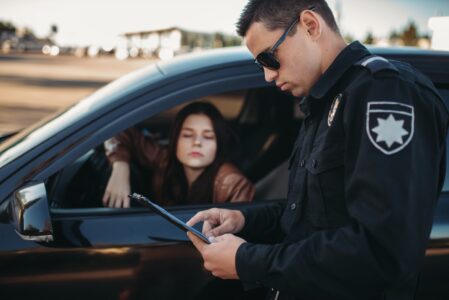
DWI charges in Kansas City rarely begin with an officer who’s specifically looking for impaired drivers. They begin with a traffic stop for something else.
A lane violation. Speeding. A broken taillight. Erratic speed that drew an officer’s attention on I-70 or one of the surface arterials. The officer approaches, observes, detects indicators of possible impairment — and the stop transitions from a routine contact to a DWI investigation.
What the officer observes during that transition matters enormously. The smell of alcohol. Slurred speech. Slow response to questions. Eyes that show nystagmus on the horizontal gaze test. Difficulty producing documents. These observations get documented in the report that follows the arrest, and that report becomes the foundation of the prosecution’s case alongside any chemical test results.
The driving behavior that prompted the stop also gets documented — and a pattern of erratic driving that preceded the stop can be cited as independent evidence of impaired condition even when chemical test results are borderline.
Field Sobriety Tests and Chemical Testing — What They Actually Determine
Let me explain what these tests do and don’t establish, because that understanding matters for how a defense gets built.
Field sobriety tests — the horizontal gaze nystagmus, walk and turn, and one-leg stand — are standardized behavioral assessments. They’re designed to detect indicators of impairment. They’re not infallible. Environmental conditions, physical limitations, nervousness, medication effects on balance or coordination, and inconsistencies in how the tests were administered can all affect results in ways that create genuine questions about what they actually establish.
Chemical testing — breathalyzer or blood draw — produces the BAC measurement. Missouri’s implied consent law creates a framework where refusing chemical testing after a lawful arrest triggers an automatic one-year license revocation that operates independently of the criminal case. Whether to submit to chemical testing involves considerations specific to each situation, which is why understanding the full picture before that decision comes up matters.
A Missouri traffic ticket lawyer who handles DWI cases in Kansas City understands how each element of the prosecution’s case gets built and where the defensible space actually lives. Speeding Ticket KC works with Kansas City drivers facing DWI charges — including situations involving medications, borderline BAC measurements, and cases where the field sobriety test administration has issues worth examining. Getting legal guidance before making any decisions about how to respond is where the most important work happens.
Questions: Drivers Ask About What Leads to DWI Charges
1. Can a valid prescription protect me from a DWI charge in Missouri?
No — and this surprises many people. Missouri’s DWI statute covers operating while in a drugged condition, and the lawfulness of the prescription doesn’t create a defense to impairment. The question is whether the substance affected the driver’s ability to operate a vehicle safely, not whether taking it was lawful. Prescription medications with driving-impairment warnings create real legal exposure when driving occurs while those effects are active.
2. Can I be charged with DWI in Missouri if I refused the breathalyzer?
Yes. Refusing chemical testing triggers its own administrative license revocation, but it doesn’t prevent a DWI charge. The prosecution can build a case on field sobriety test results, the officer’s documented observations, driving behavior, and any other evidence of impaired condition. In some cases, refusal can be argued as consciousness of guilt. Understanding the full consequences of refusal before making that decision is something an attorney can help with.
3. What driving behaviors typically lead to a DWI stop in Kansas City?
Erratic speed, lane weaving, driving significantly below the speed of surrounding traffic, slow reaction to signals, wide turns, and driving without headlights after dark all generate the kind of officer attention that leads to DWI investigations. The driving behavior that prompts the stop gets documented alongside field sobriety test results and chemical testing, and it becomes independent evidence of impaired condition in the prosecution’s case.
4. Can I be charged with DWI based only on what the officer observed without a chemical test?
Yes. Missouri’s DWI statute requires proof of an intoxicated or drugged condition — not proof of a specific BAC level. An officer’s observations of behavior, demeanor, speech, and physical indicators, combined with field sobriety test performance, can support a charge and a conviction without a chemical test result. Chemical testing is one path to establishing the condition; observable impairment evidence is another, and the two aren’t mutually exclusive.
5. How quickly should I contact a lawyer after a DWI stop in Kansas City?
Immediately — before making any statements beyond what the situation legally requires. Missouri’s administrative license revocation process has a fifteen-day deadline from the arrest date to request a hearing, and missing that window results in automatic license loss regardless of the criminal case outcome. Evidence from the stop is most accessible right after the incident. Speeding Ticket KC works with Kansas City drivers from the immediate aftermath of DWI stops through full resolution — and early involvement consistently produces the broadest range of available options.