
Speeding is one of the main causes of traffic accidents that lead to fatalities. Establishing fault and liability in accidents requires pinpointing the precise role that speed played in the collision. To confirm exactly how speed contributed to car accidents, investigators use different types of evidence, which lays the groundwork for future legal actions as well as insurance claims.
The Significance of Speed in Accident Investigations
Reaction Time and Speed
A driver’s ability to react to hazards is significantly diminished at higher speeds. A driver’s reaction distance increases by roughly 30 to 40 feet for every 10 mph increase in speed. At 60 mph a vehicle leaves minimal time to react to sudden obstacles. This diminished reaction window directly correlates with crash severity; the higher the speed, the greater the force of impact, resulting in more serious injuries and property damage.
Legal Implications of Speeding
From a legal perspective, exceeding posted speed limits constitutes negligence in most jurisdictions. This means drivers who speed are presumptively negligent, significantly affecting liability determinations. In personal injury claims, evidence of speeding can transform a standard negligence case into claims involving reckless or wanton conduct, potentially opening the door to punitive damages beyond compensatory awards.
Key Types of Evidence Used to Prove Speeding
Physical Evidence at the Scene
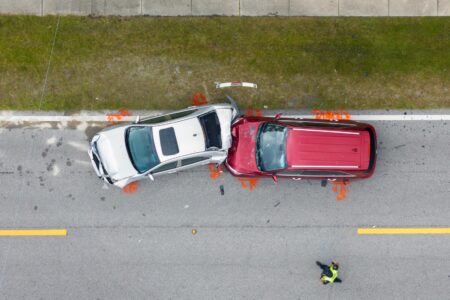
Investigators meticulously document accident scene evidence like skid mark patterns, which reveal crucial information about a vehicle’s speed before braking. The distribution pattern of accident debris (how far pieces traveled from the point of impact) provides additional speed indicators. Impact damage severity, particularly crush depth measurements, help reconstruction experts calculate collision forces and corresponding speeds. Road conditions, including weather and visibility, contextualize these physical clues.
Vehicle and Digital Data
Modern vehicles contain Event Data Recorders (EDRs) that capture pre-crash information including speed, brake application, and throttle position in the seconds before impact. Similar to a plane’s “black box”, this data often provides irrefutable evidence, including a vehicle’s speed. Additionally, GPS records, smartphone data, and onboard diagnostic systems may preserve speed information that proves invaluable during investigation.
Witness Statements and Surveillance
Eyewitness testimony about a vehicle’s perceived speed, while subjective, remains important corroborating evidence. Increasingly, investigations incorporate video evidence from traffic cameras, business surveillance systems, and dashcams that objectively document pre-crash vehicle speeds and driver behaviors.
How Speed-Related Evidence Shapes Case Outcomes
Accident Reconstruction
Forensic engineers use collected evidence to create scientific reconstructions of accidents, applying physics principles to determine speeds, trajectories, and impact forces. These reconstructions establish crucial timelines (precisely when braking occurred relative to impact) and often become centerpieces of both civil and criminal proceedings.
Insurance and Legal Consequences
Insurance adjusters heavily weigh speed evidence when determining fault percentages and coverage obligations. In more serious cases, documented excessive speed can elevate charges from minor traffic violations to criminal offenses like reckless driving or vehicular homicide, carrying potential imprisonment and significant financial penalties.
The Role of Speed in Accident Investigations
Speed related evidence forms the backbone of effective accident investigations, providing the scientific basis for fault determination and appropriate compensation. The swift collection of this evidence (before skid marks fade or electronic data is overwritten) often determines case outcomes.