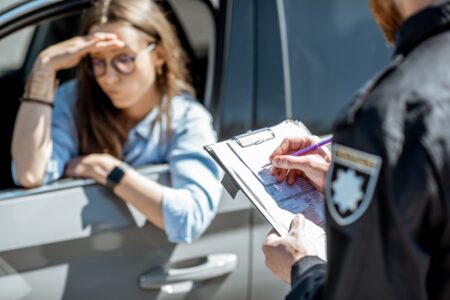

Clipping a curb feels more embarrassing than anything else. You misjudged a turn, cut a corner too tight, or pulled forward too far and bumped over the concrete edge. It happens — usually in parking lots, at tight intersections, or during parallel parking attempts that didn’t quite work out. But driving over a curb in Kansas City can result in a traffic citation, and depending on what happened afterward, the legal consequences can extend well beyond what most drivers expect from such a brief moment.
What Missouri Law Says About Leaving the Roadway
Missouri law under RSMo § 304.015 and related statutes requires drivers to stay within the designated travel portion of the road. A curb marks the boundary between the roadway and areas not intended for vehicle travel — sidewalks, landscaped medians, pedestrian zones, private property edges. Crossing over a curb without a lawful reason places your vehicle outside the travel area the law requires you to stay within.
The phrase “without a lawful reason” does real work here. Pulling over a curb to avoid a collision or respond to an emergency is different from clipping a curb because you turned too sharply while distracted. Officers look at the circumstances, the evidence at the scene, and what the driver said immediately after the incident. Those early details shape how the event gets documented — and documentation shapes what you’re charged with.
When Curb Incidents Become Legal Problems
Not every curb clip generates a citation. Officers have discretion in documenting and charging these incidents. But several scenarios consistently move from “embarrassing moment” to “actual legal problem.”
Sidewalk intrusion is one of them. If your vehicle crossed the curb and traveled onto a sidewalk — even briefly — that creates a distinct safety issue. Pedestrians use sidewalks as a protected zone, and a vehicle entering that space, even at low speed, is treated seriously by officers who respond.
Property damage is another factor. If you crossed a curb and damaged landscaping, a fence, a mailbox, a fire hydrant, or any other property — public or private — Missouri law requires you to stop and report the damage. Leaving without reporting creates a separate hit-and-run-type violation layered on top of the original incident.
Pedestrian or cyclist proximity changes things dramatically. A vehicle that crossed a curb near a person walking or cycling — even if no contact occurred — can result in a careless driving citation based on the hazard created rather than actual injury.
And if contact did occur — if a pedestrian, cyclist, or parked vehicle was struck — the legal situation changes significantly. Injuries open the door to reckless driving charges and civil liability simultaneously.
What Charges Actually Follow a Curb Incident
The most common charge is careless driving under RSMo § 304.012 — operating a vehicle in a way that endangered people or property through a lapse in attention or judgment. It’s a moving violation. Two points on your Missouri license. Fines between $100 and $200 before court costs.
Failure to maintain lane under RSMo § 304.015 is another possibility if the incident is documented as leaving the designated travel area. The two charges sometimes both appear on a single citation, depending on what the officer documented.
Missouri’s point system suspends licenses at eight points within 18 months. If you’re already carrying points from a prior violation, two more push you closer to that threshold. Insurance companies review your record at renewal — a rate increase holding across two or three policy terms regularly costs more than the original fine.
A Missouri traffic ticket lawyer can help you understand what you’re actually facing and where realistic options exist before you decide how to respond.
How Speeding Ticket KC Handles These Cases
Speeding Ticket KC is a recognized law firm in Kansas City, Missouri. They handle traffic violations and related defense matters — including careless driving and roadway boundary citations that stem from curb incidents and parking lot accidents.
Their attorneys review each case on its own specific facts. What exactly was cited? What did the officer document? Is there dashcam footage, parking lot camera video, or witness accounts that tell a different story? What outcomes are genuinely available — reduction, dismissal, a negotiated result that limits damage to your record? No templates. Each case is read for what it actually contains.
What to Do After a Curb Incident
If you clipped a curb and nothing was damaged and nobody was nearby, document what happened and keep moving with your day. But if there was property damage, a pedestrian or cyclist in the vicinity, or an officer arrived at the scene — take the situation seriously from that point forward.
Write down everything while details are still fresh. The location, what you were doing, what you could see, road conditions, and what the officer said. If you have dashcam footage, save it immediately before it overwrites. If property was damaged, document what was damaged and where, even if you stayed and reported it — your own documentation matters.
Don’t pay a citation automatically without understanding what it actually means for your record and insurance. Payment is a legal admission. Points attach immediately. Your insurer sees it at renewal.
Contact a lawyer before your court date. Options narrow as deadlines pass, and knowing what’s realistically available early gives you room to respond with intention rather than just absorbing the consequences of a moment that lasted less than a second.
The gap between a driver who comes out of this with a clean record and one who ends up with points, higher insurance, and a citation on their history often comes down to whether they got informed before the deadline closed — not after.