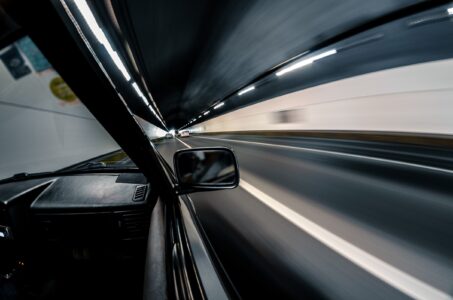

You know that moment when a car rounds the bend, and it’s like someone just aimed a flashlight straight at your face? Yeah. That’s usually a dimming violation happening in real time, and Missouri actually has a law written specifically for it.
Most people never think about their high beams until they’re on the receiving end of someone else’s. You flip them on for a dark stretch, forget about them completely, and next thing you know, you’re blinding every car coming the other direction. Happens constantly out past the edges of Kansas City, where the streetlights thin out and the roads get genuinely dark. So — what does the law say, why does anyone bother enforcing it, and what does a ticket for it actually mean for you? Let’s get into it.
The Actual Rule, Without the Legal Fog
Missouri Revised Statute 307.070 spells this out, though the wording feels like it hasn’t been touched since typewriters were standard office equipment. If your car has both high and low beam settings — and almost every car does — you’re required to switch to low beams in two situations: when an oncoming car is within five hundred feet of you, or when you’re following another vehicle within three hundred feet.
Five hundred feet is farther than most people would guess if you asked them cold. That’s close to a football field and a half, end zone to end zone and then some. So here’s a decent rule of thumb: if you can see another car’s headlights coming at you on a straight road, you’re almost certainly already inside that range. Dim now, not later.
There’s also language in the statute about beam height and angle — the kind of technical detail that reads more like something out of an engineering spec sheet than an actual law. What it boils down to, though, is simple enough: your high beams can’t throw glare high or wide enough to hit an oncoming driver’s eyes, even from a distance. Factory headlights are built to meet that standard. A misaligned headlight, or a cheap aftermarket bulb kit someone installed themselves on a Saturday afternoon, can throw the whole thing off without the driver ever realizing it.
Why This Isn’t Just a “Minor Annoyance” Ticket
Bright lights at night don’t just annoy people. They blind them, for real, for a handful of seconds that matter more than you’d think. Ever had your vision go completely white right after an oncoming car blew past with its brights on? That’s not you being dramatic. It’s called disability glare, and depending on the person, your eyes can take several seconds to recover.
A few seconds don’t sound like a big deal until you do the math. At highway speed, a car covers well over a hundred feet every single second. Blink through five seconds of near-blindness, and you’ve just driven the length of several football fields without actually seeing the road in front of you. That’s the real reason Kansas City officers and the Missouri Highway Patrol don’t wave this one off, even though on paper it seems small next to speeding or reckless driving charges.
Under the statute, this is classified as an infraction — a step below a misdemeanor. Lesser charge, sure. Doesn’t mean it’s free, though. There’s still a fine attached, and depending on how the citation gets processed in your county, it can still show up on your record.
Where These Tickets Tend to Come From
Talk to enough people who’ve gotten one of these, and you start noticing the same handful of situations over and over. Most of them aren’t about anyone being a jerk on purpose — it’s usually just carelessness, or genuinely not realizing what’s happening.
- Forgetting the brights are still on after switching them for a dark, unlit highway stretch
- Misjudging distance on curves or hills, where five hundred feet is harder to gauge than it sounds
- Running aftermarket LED bulbs that never got properly aligned during install
- Tailgating with brights on, without realizing the glare bouncing off someone’s mirrors is just as blinding as facing them head-on
That last one trips people up more than you’d expect. You don’t have to be facing someone directly to blind them. Mirrors do a lot of that work quietly, and most drivers never think about it until it’s their ticket.
So You Got the Ticket — Now What
Once an officer pulls you over for this, you’ll get a citation. Usually a fine, sometimes a court date if you’d rather fight it. A lot of drivers just pay it and move on — easier, faster, done with it. And look, sometimes that’s genuinely the right call.
But paying it outright still counts as an admission of guilt, for what it’s worth, and infractions can still land on your driving record depending on your county and how the court processes things. It’s not always the harmless little ticket people assume it is. Insurance companies pay attention to patterns more than severity — a string of small violations can raise eyebrows just as fast as one big one does.
Talking to a Missouri traffic ticket lawyer before your court date is generally worth the twenty minutes, especially if you’ve already got a violation or two on file, or if something about the traffic stop itself felt off. A lawyer who works Kansas City traffic courts regularly can usually tell you pretty fast whether it’s worth fighting or whether it’s smarter to just handle it and move on with your life.
A Few Defenses That Sometimes Hold Up
Not every one of these citations is as solid as it looks on paper, and this violation has more gray area than most. Distance estimation is subjective by nature. Officers are eyeballing that five-hundred-and-three-hundred-foot mark in most cases, and judging distance at night, especially across curves or hills, isn’t exactly an exact science — even for someone experienced at it.
Equipment problems come up a lot too. If your headlights were misaligned because of a mechanical issue you had no idea about, or aftermarket bulbs were installed by a shop that botched the alignment, that context can genuinely matter in court. It won’t automatically get the ticket dismissed. But it’s worth raising rather than just assuming the citation is unbeatable.
Don’t Just Shrug This One Off
A headlight dimming ticket feels small compared to most things that show up in traffic court. In a lot of ways, it is small. But small doesn’t mean harmless, particularly once it’s sitting on your record next to whatever else might already be there.
If you’ve picked up a citation for failing to dim your lights anywhere around Kansas City, it’s worth spending a few minutes figuring out what you’re actually up against before just writing the check. Speeding Ticket KC deals with cases like this constantly, and getting a Missouri traffic ticket lawyer’s honest read before your court date can save you both money and a headache you didn’t need.