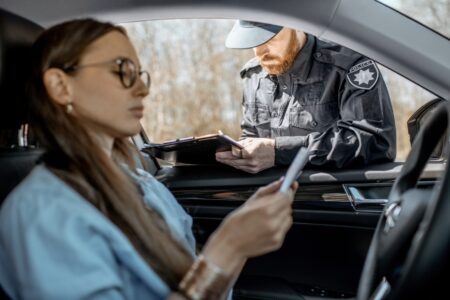
Police determine whether you were speeding through tools and observations such as radar, lidar, pacing, visual estimation, or recorded evidence. The method used matters because the officer generally needs reliable evidence showing both your vehicle’s speed and the vehicle’s identity.
If you have ever wondered how much over the speed limit can you go, there is no universal amount that automatically makes speeding acceptable. The applicable speed limit and state traffic laws determine the violation, while the evidence gathered by police helps establish whether your vehicle exceeded that limit.
1. Radar Measures Speed Electronically
Radar sends radio waves toward traffic and analyzes the returning signal to calculate a vehicle’s speed. Officers may use handheld units, patrol-car radar, stationary radar, or moving radar while their vehicle is also traveling.
Because radar can detect multiple vehicles in some circumstances, identifying the correct vehicle matters. An officer may consider lane position, traffic, distance, and visual observations when connecting a radar reading to a particular car.
Courts may also consider whether the equipment was properly operated, tested, maintained, and used by a trained officer.
2. Lidar Focuses on One Vehicle
Lidar, or laser speed detection, uses pulses of light to calculate speed and distance. Its narrow beam generally allows an officer to target a particular vehicle more precisely than radar.
Typically, the officer:
- Spots a vehicle believed to be speeding
- Aims the device at it
- Obtains a speed reading
- Confirms the vehicle’s identity and location
- Stops the vehicle or records the violation
Questions about targeting, device operation, testing, training, or environmental conditions can affect how a lidar reading is evaluated.
3. Officers Can Use Pacing
Pacing involves following a suspected speeding vehicle at a relatively constant distance and comparing its speed with the patrol car’s speedometer.
A stronger pacing observation may involve a sustained period during which the distance remains reasonably consistent. The officer may need to explain how long the vehicle was followed, whether the patrol car changed speed, and whether its speedometer was accurate.
Briefly driving behind another vehicle does not necessarily provide the same evidence as maintaining a stable pace.
4. Visual Estimation Can Matter
Officers can also estimate speed by watching how quickly a vehicle moves compared with surrounding traffic, roadside objects, lane markings, or known distances.
The officer’s training and experience can influence how much weight is given to that observation. Visual estimation may also be considered alongside radar, pacing, or other evidence.
The key issue is whether the observation provides a sufficiently reliable basis for concluding that the vehicle exceeded the applicable limit.
5. Cameras and Recorded Evidence May Help
Some jurisdictions use automated speed cameras, patrol-car video, toll-road systems, aircraft timing, or other technology. Recorded evidence may show:
- The vehicle’s speed
- License plate information
- Date and time
- Location
- Applicable speed limit
- Photographs or video
Camera enforcement varies by jurisdiction. Local law may determine whether automated enforcement is permitted and what notice, authentication, owner-liability, and hearing procedures apply.
What Speed Limit Actually Applies?
A posted limit is not always the only applicable rule. Some states also have basic speed rules requiring drivers to travel at a reasonable speed considering traffic, weather, visibility, road conditions, and other circumstances.
Under federal law, 23 U.S.C. § 402 supports state highway-safety programs aimed at reducing crashes and injuries associated with speeding.
Final Takeaways
- Police can use several methods to measure speed.
- Radar and lidar provide electronic speed readings.
- Pacing compares your speed with a patrol vehicle.
- Visual observations can also support enforcement.
- Cameras may provide recorded evidence of violations.
- State and local laws determine applicable speed limits.
- The reliability and identification of evidence matter.