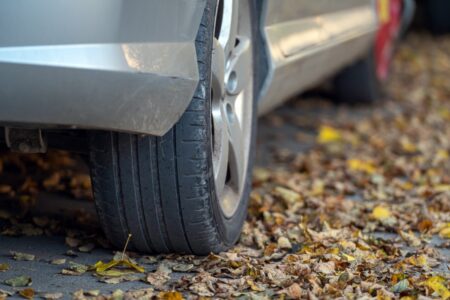

It starts with that familiar thud. A tire rolling up over a concrete edge — maybe during a tight turn in an older neighborhood, maybe while parallel parking on a busy street near the Plaza, maybe while navigating one of Kansas City’s narrower residential corners. The sound is unmistakable. Most drivers wince, check the steering wheel, and keep moving.
What happens next depends entirely on what the curb crossing actually involves. And the range of consequences is wider than most drivers expect when that thud registers.
A Curb Is a Legal Boundary, Not Just a Physical One
This is where most drivers’ mental model of the situation breaks down. The curb isn’t just a concrete edge that separates the road from the sidewalk or grass. It’s a legal boundary — the line between designated roadway and everything that isn’t. Missouri traffic law requires vehicles to be operated on designated roadways. Crossing that boundary, even briefly, means operating outside the space the law assigns to vehicles.
The legal significance flows from what the boundary protects. Curbs define the edges of pedestrian zones, property lines, and safe space for people who aren’t in vehicles. When a car crosses a curb — onto a sidewalk, over a landscaped median, onto private property — it enters spaces where other people have a legitimate expectation of safety. That expectation is what the law is protecting, and it doesn’t require an injury to trigger legal accountability.
Kansas City officers understand this, which is why curb violations get cited more often than many drivers expect. The question isn’t just whether anything bad happened. It’s whether the vehicle operated outside its designated space — and often the answer is clearly yes, even for incidents that felt minor at the time.
The Specific Kansas City Situations That Produce Citations
Kansas City’s road network creates specific curb violation patterns that officers recognize and watch for. Understanding them matters both for prevention and for understanding what context a defense needs to address.
Tight turns in older neighborhoods produce a significant share of these incidents. Midtown, Westside, Waldo, Northeast Kansas City — these neighborhoods have road geometries that predate modern vehicle sizes. An SUV or truck navigating a corner designed for 1940s-era cars frequently runs out of room. The turn goes wide, the tire clips the curb, and if an officer has line of sight, the incident is documented.
Parallel parking attempts are another consistent source. Busy commercial streets — near the Crossroads, along Main Street, on Broadway through Westport — require precision in tight spaces. A driver who misjudges the gap and rolls partially onto the curb during a parking attempt can face a citation even though they were moving slowly and had no intention of leaving the roadway.
Traffic avoidance shortcuts generate the most deliberate category of violations. A driver sitting in a queue, spotting what looks like passable space near the curb, edges over to get around stopped traffic. The shortcut takes fifteen seconds. The citation is real. Officers who see this pattern — particularly during peak congestion on busy commercial corridors — respond to it as a deliberate choice rather than an accident, which affects how the case gets handled.
Construction zones create genuine confusion. Kansas City’s ongoing road projects regularly produce situations where the boundary between the travel lane and adjacent surfaces isn’t clearly marked. A driver following temporary lane guidance who inadvertently crosses onto a curb area may have a legitimate confusion argument — but only if the specifics actually support it.
When Curb Crossings Create Property Damage
Here’s where the consequences branch in ways that change the entire legal picture.
A curb crossing that stays on public pavement — a tire that rides up over a concrete curb and comes back down without contacting anything else — is one situation. Manageable with the right legal help.
A curb crossing that involves property damage is a different animal entirely. Kansas City businesses, residences, and public infrastructure sit adjacent to curbs throughout the city. A vehicle that crosses a curb and strikes a planter box, a sign, a utility fixture, a parked bicycle, a mailbox, or any other property has created a separate civil liability in addition to the traffic citation.
Missouri’s accident reporting requirements apply when property damage occurs. Under RSMo § 577.060, damage exceeding $500 triggers a mandatory reporting obligation — and modern property repairs clear that threshold easily. A broken sign, a damaged planter, a bent railing — the repair cost almost always exceeds $500. A driver who causes that damage and doesn’t report it has added a failure-to-report violation to the original curb citation.
The driver who keeps moving after property damage — even low-speed, seemingly minor property damage — faces potential hit-and-run implications if the damaged property belongs to someone else and the incident goes unreported. That’s a significant escalation from a moving violation. It takes a situation that might have been resolved with legal help and adds a misdemeanor-level exposure that changes everything about the required legal response.
The Traffic Citation Consequences on Their Own
Setting aside property damage complications, the traffic citation from a curb violation carries its own set of consequences worth understanding clearly.
Two to four points on a Missouri license, depending on how the citation is written and which statute or ordinance applies. Kansas City municipal code and Missouri state statute can both apply to curb violations — and how the officer writes the citation determines which court handles it, what the fine schedule is, and what the point impact is. These distinctions affect every subsequent decision.
Missouri suspends licenses at eight points within 18 months. Two to four points from a single curb citation can represent a significant portion of that threshold for a driver with prior violations. The addition isn’t trivial just because the underlying incident felt trivial.
Insurance responds to moving violation convictions at renewal. A curb violation conviction signals imprecise vehicle control to carriers — not a dramatic risk indicator, but a flag that adjusts the premium calculation. Increases of 15 to 25 percent for a single moving violation aren’t unusual, and they compound across renewal periods. The total cost over three years often exceeds the original fine by a meaningful margin.
Paying the citation without reviewing options locks all of this in permanently. Once paid, the conviction is settled — on the record, counted in points, visible to insurers at renewal. There’s no subsequent negotiation or reduction available.
A Missouri traffic ticket lawyer at Speeding Ticket KC reviews curb violation citations before any payment decision gets made. The firm handles both city ordinance citations and state statute violations throughout Kansas City, understands how these cases move through local courts, and can assess whether a specific citation has weaknesses worth pressing or a realistic path to reduction. Many clients resolve these cases without appearing in court at all.
The Property Damage Situation Needs Its Own Strategy
If a curb incident involves property damage, the response needs to account for two separate legal dimensions simultaneously — and they need to be handled carefully to avoid making either situation worse.
The traffic citation and the property damage issue don’t always get resolved in the same venue or under the same legal framework. A traffic court resolution doesn’t automatically address civil liability for the damaged property. Statements made in one context can affect the other. How you respond to the property owner, to their insurance, or to law enforcement can influence both the criminal and civil picture in ways that aren’t always obvious.
Getting legal advice before making statements or decisions — in either direction — is the move that preserves the most options. An attorney who understands both the traffic citation dimension and the property damage dimension can help navigate a response that doesn’t inadvertently create problems in one area while addressing the other.
Questions Drivers Ask After a Curb Violation Incident
1. Do I have to report the incident if I hit property near the curb?
If the damage exceeds $500 — which most property damage does, given current repair costs — Missouri law requires reporting. The threshold is lower than most drivers assume. A damaged planter, a broken sign, a bent railing, a clipped mailbox — these repairs routinely exceed $500. Failing to report creates a separate violation on top of any traffic citation. If property damage was involved, contact an attorney before deciding how to proceed with reporting, because the sequence and content of what you report matters.
2. What if the curb crossing was clearly accidental?
Accidental versus deliberate affects how prosecutors approach the case and what reduction options exist — but it doesn’t eliminate the violation. The traffic infraction exists regardless of intent. What accidental context does is support a stronger argument for reduction or dismissal, particularly for first-time offenders where there’s no pattern of similar behavior. Document what you remember about the road conditions, the turn requirements, any factors that contributed — specific details build the argument that inadvertence was the cause.
3. Can a curb citation be reduced to a non-moving violation?
Yes, in the right circumstances. Non-moving violation reductions eliminate the point impact and the insurance signal entirely. First-time offenders with clean driving histories have realistic access to these reductions through negotiation in Kansas City courts. Speeding Ticket KC handles these negotiations and gives clients an honest read on what’s achievable based on the specific facts — not generic optimism, but a realistic assessment of the actual case.
4. What if I hit a curb because of road conditions or construction?
Construction zone confusion and poor road markings are legitimate contextual factors that courts consider. If temporary lane markings were unclear, if construction signage created ambiguity about where the roadway ended, or if road conditions contributed to the wide path — document the situation immediately. Photographs of the road configuration, the markings, any construction signage visible from the driver’s approach angle — that documentation supports a defense that the crossing wasn’t a conscious choice but a product of inadequate guidance.
5. How quickly do I need to respond after receiving this citation?
Faster than most people move. Kansas City court dates arrive sooner than drivers expect, and response deadlines are real. Missing a deadline adds failure-to-appear consequences on top of the original citation — an entirely avoidable problem. Speeding Ticket KC recommends reaching out within days of receiving any citation involving a curb incident, not weeks. Early contact means more time to assess the documentation, understand the specific charges, and pursue the best available outcome before any windows close permanently.
Endnote
Driving over a curb reads as a minor incident until the full picture of consequences becomes clear — the points, the insurance adjustments, the property damage exposure, the potential escalation if the driver kept moving. None of it matches how the thud felt in the moment. Knowing what you’re actually dealing with, and making decisions based on that knowledge rather than assumption, is always the better starting point.