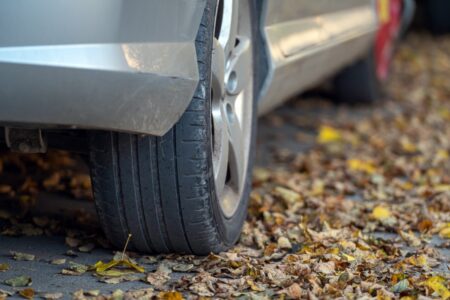

You know that sound. The dull thud of a tire rolling up over concrete — maybe on a tight residential corner in Westside, maybe during a parallel parking attempt on a busy stretch near Westport, maybe while navigating one of those impossibly narrow old streets in Hyde Park where both cars have to partly stop just to pass each other. The thud happens, you wince a little, check the steering, and keep moving.
This article is part of our guide to failure to signal tickets in Kansas City.
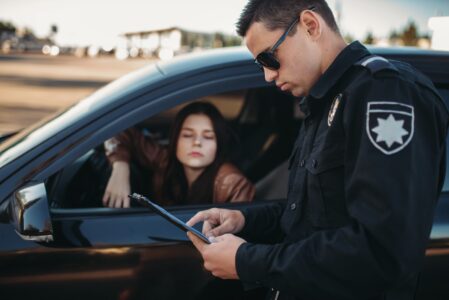
Then you see the lights. Getting cited for driving over a curb catches most drivers completely flat-footed. It doesn’t feel like a real violation — it feels like a parking mishap, or an awkward turn, or just one of those things that happens on Kansas City’s older streets. The gap between how it felt and what Missouri law says about it is significant. And the consequences that follow are more substantial than the incident itself suggests.
Why Crossing a Curb Is Actually a Legal Event
Let me explain this clearly, because it’s the piece most drivers don’t fully process until a citation is in their hand.
A curb isn’t just a physical feature of the road. It’s a legal boundary — the line between the designated roadway and everything that isn’t. Missouri traffic law requires vehicles to be operated on designated roadways. When a vehicle crosses that boundary onto a sidewalk, landscaped area, or adjacent property, it’s technically operating outside its legally designated space.
The law doesn’t require an injury to occur. It doesn’t require another person to be present. It doesn’t require the vehicle to travel along the curb for any particular distance. The crossing itself is the issue — because what the law is protecting is the space on the other side. Sidewalks, pedestrian areas, private property edges — these are spaces where people have a reasonable expectation that vehicles won’t appear. Curbs define that expectation. Officers who see a vehicle cross one have clear grounds for a citation. Learn more about crosswalk and pedestrian tickets in Kansas City.
This is why these violations produce genuine legal consequences even when the incident felt minor. The law isn’t calibrated to how minor it felt. It’s calibrated to what the boundary is there to protect.
The Kansas City Situations That Actually Produce These Tickets
Kansas City’s road network creates specific conditions where curb violations happen with regularity. Knowing the patterns helps — both for understanding how a citation came about and for identifying what context might support a defense.
Older neighborhood streets are the most common setting. Kansas City neighborhoods like Midtown, Northeast, Westside, and Waldo have road geometries designed for a different era. Streets are narrower, corners have tighter radii, and a modern SUV or truck navigating them has genuinely less margin than the infrastructure was built to accommodate. A turn that goes slightly wide — not because the driver was careless, but because the physics of a large vehicle on a tight corner require it — produces a curb crossing that an officer with line of sight can cite.
Parallel parking attempts generate their own category. Commercial streets near the Plaza, along Main Street, on Brookside Boulevard — parallel parking in tight urban spaces requires precision under pressure. A driver who misjudges the gap between their rear tire and the curb and rolls up onto the concrete during the parking sequence faces a citation even at minimal speed with no intent to leave the roadway. See our guide to lane departure tickets in Kansas City.
Traffic avoidance shortcuts are treated most seriously. A driver who rolls onto the curb area deliberately — to get around a stopped vehicle, to cut the corner of a congested intersection, to save thirty seconds in a queue — is making a deliberate choice to use non-roadway space as a travel route. Officers characterize this differently than an accidental overshoot, and the citation often reflects that distinction in its language and the specific statute cited. Read more about tickets for striking a parked car in Kansas City.
Construction zone confusion is a genuine factor in some cases. Kansas City’s perpetual road projects regularly blur the boundary between travel lanes and adjacent surfaces with confusing temporary markings, displaced lane lines, and detour configurations that don’t communicate clearly where the roadway ends. A driver following construction signage who inadvertently crosses onto a curb area has a legitimately different situation than one who deliberately cuts a corner — but the defense still needs to be grounded in specific details about the road configuration, not a general claim of confusion.
What Gets Written on the Citation — and Why It Matters
RSMo § 304.015 governs roadway operation broadly and provides the state statute basis for most curb violation citations. Kansas City municipal code Section 70-405 addresses sidewalk driving specifically and can be cited instead of or alongside the state statute.
How the officer writes the citation — which statute or ordinance they invoke — affects the point value, the fine schedule, and which court handles the case. Municipal ordinance violations go through Kansas City municipal court. State statute violations may route differently. The procedures, the fine schedules, and the negotiation dynamics differ between these tracks, and understanding which one applies to your specific citation is a necessary first step before making any decisions.
Officers have discretion in how they characterize what they observed. A brief, unintentional curb clip during a parking maneuver can be written up differently than a deliberate curb-crossing to avoid traffic. That characterization affects every subsequent option — which is why having someone who knows how Kansas City courts handle these specific citations matters when deciding how to respond.
The Financial Picture That Surprises Most Drivers
Two to four points on a Missouri license, depending on how the citation is written. Against Missouri’s eight-point license suspension threshold within 18 months, that’s a meaningful addition for any driver carrying prior violations.
Fines vary based on the specific charge and jurisdiction. Court costs add to the base fine regardless of the specific statute cited. Neither the fine nor the court costs are the biggest financial exposure — that’s the insurance impact, which compounds over time in ways that don’t appear on the face of the citation.
Moving violation convictions signal risk to insurance carriers at renewal. A curb driving conviction sits in the record as evidence of imprecise vehicle operation. Premium increases of 15 to 25 percent for a single moving violation aren’t unusual. Sustained across multiple renewal periods, even a modest premium increase from a minor-seeming citation adds up to real money. Learn more about moving vs. non-moving violations in Missouri.
Paying the ticket immediately closes every other door. Once paid, the conviction is settled — permanent, counted in points, visible to insurers, not subject to further challenge or review. A Missouri traffic ticket lawyer at Speeding Ticket KC looks at these citations before any payment decision gets made. The firm handles curb violation cases under both city ordinance and state statute throughout Kansas City, and knows how local courts evaluate these charges. For many clients, the consultation changes what they decide to do — and what outcomes are actually available to them.
When a Curb Citation Grows Into Something More Serious
Most curb violations stay in traffic court. A fine, some points, a record entry — significant in aggregate, but manageable with the right legal response. See our guide to disobeying railroad signals and gates in Kansas City.
Several factors push situations beyond that baseline.
Pedestrian presence is the most serious escalating factor. If a pedestrian was on or near the sidewalk when the vehicle crossed the curb — even without contact — officers can characterize the incident as reckless endangerment of a person. That’s a misdemeanor, not a traffic infraction. Different penalties, different court track, different level of prosecutorial attention. Read more about whether a traffic ticket is a criminal offense in Missouri.
Property damage during the curb crossing adds civil exposure alongside the traffic citation. A vehicle that struck a sign, planter, mailbox, bicycle, or any other property creates a liability issue that runs parallel to the traffic charge. The two need to be navigated carefully to avoid inadvertently making either situation worse.
And if the driver left after causing pedestrian endangerment or property damage without stopping, hit-and-run implications can follow. What started as a minor traffic matter becomes something significantly more complex.
Questions Drivers Ask After a Curb Citation
1. Does it matter that the curb crossing was completely unintentional?
Intent is relevant to how the case gets characterized and what options exist — but it doesn’t eliminate the violation itself. An accidental curb clip during a parking maneuver is treated differently than a deliberate shortcut, particularly for first-time offenders where there’s no pattern of similar behavior. Document what you remember about the road conditions, the turn geometry, and any contributing factors as specifically as possible. Specific details build arguments; general claims about accidents don’t.
2. What if my vehicle is large and the corner was genuinely too tight?
Vehicle size relative to road geometry is a legitimate contextual factor, particularly on Kansas City’s older residential streets where road design predates modern vehicle dimensions. This context can support a mitigation argument — that the curb crossing was a product of infrastructure that doesn’t accommodate modern vehicles rather than careless driving. Photograph the intersection showing the turn radius and road width. That documentation gives an attorney concrete material to present.
3. Can a curb citation be reduced to a non-moving violation?
Yes, in the right circumstances. Non-moving violations eliminate the point impact and the insurance signal entirely — the most consequential practical consequences of the citation. First-time offenders with clean driving histories have realistic access to these reductions through negotiation in Kansas City courts. Speeding Ticket KC handles these negotiations and gives clients an honest read on what’s achievable based on the specific facts — not optimism, but a realistic assessment of the actual case.
4. What if there was property damage involved in the curb crossing?
Property damage changes the picture materially. It adds civil exposure alongside the traffic citation, and if the driver left without addressing the damage, potential hit-and-run implications follow. The traffic citation and the property damage issue don’t always get resolved in the same venue or under the same framework. Getting legal advice before making statements or decisions about either dimension is the move that preserves the most options and avoids inadvertently making either situation worse.
5. How quickly do I need to respond after receiving this citation?
Faster than most drivers move. Kansas City court dates arrive sooner than people expect, and response deadlines are real. Missing a deadline adds failure-to-appear consequences on top of the original citation — an entirely avoidable problem. Speeding Ticket KC recommends reaching out within days of receiving a curb violation citation, not weeks. Early contact means more time to review the documentation, assess the specific charges, and pursue the best available outcome before any windows close permanently.
Final Thoughts
A curb violation feels minor in the rearview mirror. The legal and financial consequences that follow don’t always match that feeling. Understanding what you’re actually dealing with — and making a deliberate decision about how to respond rather than defaulting to the payment portal — is what determines how this shows up on a driving record and insurance bill for the next several years.
Related questions
- Wrong side of the road tickets in Kansas City
- Weaving tickets on Kansas City roads
- Lane departure tickets in Kansas City
Need help with your ticket? Talk to a traffic ticket attorney in Kansas City, MO.
Got a traffic ticket in Kansas City? Call Speeding Ticket KC at 816-398-8772 for a free quote.