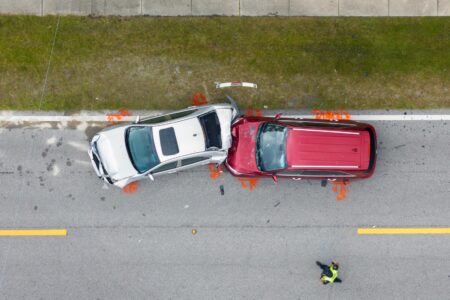

It happens before you fully register what’s occurring. Your front tires drift onto gravel, or you clip a curb coming around a bend, or you end up in a shallow ditch on a stretch of highway you’ve driven a hundred times without incident. The heart rate spikes. The car stops. And then — sometimes — the lights of a police cruiser appear in your mirror.
Roadway departure violations catch Kansas City drivers off guard constantly. Not because people are reckless, but because the causes are often painfully ordinary.
What the Law Considers a Roadway Departure
Missouri law under RSMo § 304.015 requires drivers to stay within the designated travel portion of the road. Drifting onto a gravel shoulder, crossing over a curb, leaving the pavement for a grass median, ending up in a ditch — all of it qualifies as leaving the roadway under Missouri traffic statutes.
The phrase that does real legal work here is “without lawful reason.” Pulling onto a shoulder because your tire blew out sits in a different territory than drifting off because you were scrolling through your phone. Officers document everything at the scene — tire tracks, skid patterns, final vehicle position, and any damage to roadside objects. What you say right after it happens gets written into the report, too. Those first words matter more than most drivers realize when the citation eventually lands in their hands.
The Causes — And Why They Matter Legally
Distraction causes more roadway departures than anything else. Phone use is the obvious one, but the everyday version is more subtle — a coffee cup rolling under the seat, a passenger conversation that pulled focus for three seconds, a GPS rerouting at exactly the wrong moment.
Fatigue works differently but produces the same result. Kansas City has early commuters and overnight shift workers on I-70 and I-435 every single day. That slow drift that starts before you realize your eyes have closed — it’s more common than anyone admits. Rumble strips exist for a reason.
Weather creates a different category entirely. Kansas City winters bring ice that hides on bridge decks and shaded road sections well after the sun rises. A driver going a completely reasonable speed can hit a frozen patch and lose control with no real warning. Spring flooding occasionally creates standing water that pushes vehicles sideways on roads with poor drainage. These aren’t failures of attention — they’re failures of conditions. And courts do recognize that difference, provided there’s documentation to support it.
Medical events — a seizure, sudden cardiac episode, unexpected vertigo — can also pull a driver off the road through no fault of their own. That distinction matters legally, but only when it’s properly documented and argued.
What Charges Can Follow
A roadway departure with no damage and no injuries typically results in a careless driving citation or failure to maintain lane charge. Both are moving violations — two points on your Missouri license, fines in the $100 to $200 range before court costs. Manageable on paper.
The fuller picture matters more. Missouri suspends licenses at eight points within 18 months. If you’re carrying points from prior violations, two more land harder than they look. Insurance companies notice moving violations at renewal — a rate increase holding across two or three years frequently costs more than the original fine ever did.
Property damage changes things fast. A fence, a mailbox, a parked vehicle — if you caused damage and drove away without reporting it, Missouri law treats that as a hit-and-run violation layered on top of the original incident. Staying and reporting limits the legal exposure considerably.
Injuries are where the situation shifts into genuinely serious territory. Someone hurt because your vehicle left the road opens the door to reckless driving charges and civil liability running simultaneously. That jump from routine citation to real criminal exposure happens faster than most people expect when injuries are part of the picture.
A Missouri traffic ticket lawyer can help you get a clear picture of what you’re actually dealing with before anything compounds further.
How Speeding Ticket KC Handles These Cases
Speeding Ticket KC is a well-known law firm based in Kansas City, Missouri. They handle traffic violations and criminal defense matters — including roadway departure cases that look straightforward on the citation but often carry more complexity once someone looks closely.
Their attorneys review each case on its own facts. Police report, scene evidence, road conditions, what was documented, what was said. They check whether the charge accurately reflects what happened, whether investigation procedures were followed correctly, and what realistic options exist — reduction, dismissal, or a negotiated outcome that protects your record. No templates. Each case gets read on what it actually contains.
Questions People Actually Ask
What separates a lawful shoulder stop from a roadway departure violation?
Intent and circumstances. Pulling onto a shoulder for an emergency — tire blowout, mechanical failure, a medical issue — is recognized as lawful under Missouri law. Drifting onto a shoulder because of distraction or fatigue is not. Officers look at the physical evidence and what you say at the scene to assess which category applies. Your account matters, but it carries more weight when supported by something concrete — dashcam footage, physical evidence of a mechanical failure, documented road conditions.
What if icy roads caused the departure?
Weather is a recognized legal factor in Missouri courts, but it doesn’t automatically dismiss the citation. Prosecutors look at whether your speed was appropriate for the conditions and whether the road hazard was something a reasonable driver should have anticipated. Weather reports, road condition records, and dashcam footage showing ice — these make the argument real rather than just a claim. Without documentation, “the road was slippery” is hard to make stick on its own.
Do I have to report it if no one was hurt and nothing was damaged?
If no property was damaged and no other parties were involved, Missouri’s mandatory reporting requirements are less clear-cut. But any damage at all — a mailbox, a sign, a fence — generally triggers a reporting obligation. Leaving without reporting creates a separate legal problem on top of the original incident. When in doubt, document what happened and report it. That protects you far better than hoping nothing surfaces later.
Can a medical emergency actually work as a legal defense?
Yes — when properly supported. A sudden, unforeseeable medical event that caused loss of vehicle control can negate the negligence element that courts look for in these cases. “Unforeseeable” carries real legal weight. If you had a known condition that created a risk of losing consciousness and drove anyway, that defense would weaken significantly. But a first-time seizure, an unexpected cardiac event, sudden severe vertigo — these are legitimate and recognized. Medical records and emergency documentation are what make the argument hold up in practice.
Is legal help worth it for a roadway departure citation?
Clean record, no damage, no injuries — you might get through it without lasting damage. But prior violations, property damage, any injury, or anything suggesting the charge could escalate — those are exactly the situations where representation changes outcomes more than people expect. Speeding Ticket KC handles these cases regularly and can give you an honest read on where things stand before you decide how to respond.