Slip and fall accidents often seem straightforward, but not every fall leads to a valid legal claim. To hold a business or property owner responsible, you must prove negligence. This means that you need to prove that they failed to maintain a reasonably safe environment. Understanding what legally counts as negligence helps you determine whether your case has real merit.
Understanding Negligence in Slip and Fall Cases
In a premises liability lawsuit, negligence occurs when a property owner fails to take reasonable steps to prevent foreseeable hazards that could harm visitors. Negligence is built on four specific legal elements, and all must be present:
- Duty of care: The owner had a responsibility to keep the property safe
- Breach of duty: The business or owner failed to meet that responsibility
- Causation: That failure directly led to your fall
- Damages: As a result, you suffered actual harm, such as injury, medical bills, and lost income
If even one of these elements is missing, the claim becomes weak or invalid.
What Counts as a Breach of Duty
Slip and fall incidents are not rare or minor. The CDC states that about 14 million older adults report falling each year, and about 37% of those falls result in injuries requiring medical treatment. This highlights how serious these accidents can be and why property safety standards exist in the first place.
The strongest slip and fall cases focus on clear, preventable hazards that were ignored. Courts typically look for situations where the danger was known, or should have been known, and not fixed in time. Concrete examples include:
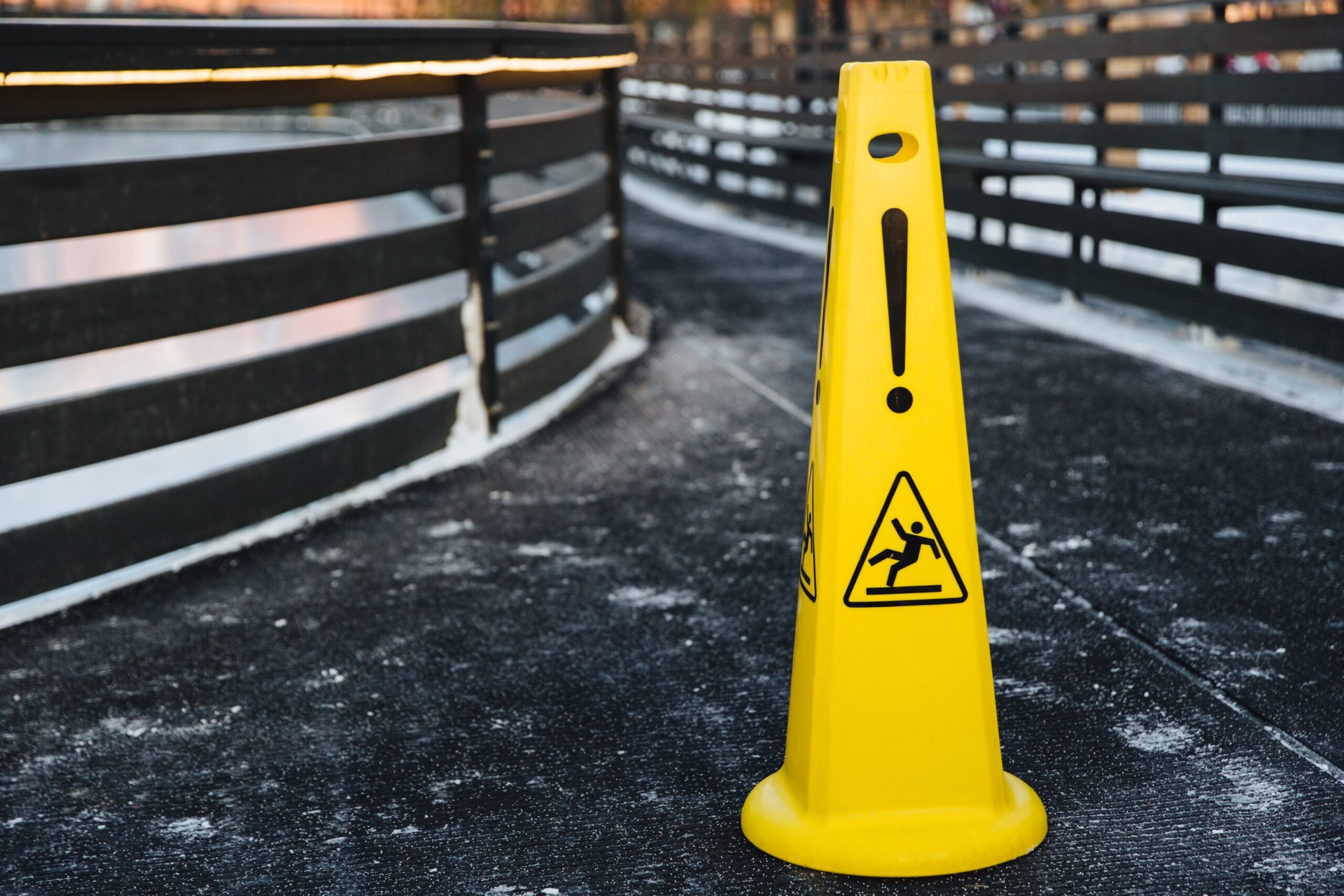
- Wet floors without warning signs
- Spilled liquids left unattended for long periods
- Broken stairs or missing handrails
- Uneven flooring or loose tiles
- Poor lighting in walkways or staircases
- Ice or snow not cleared within a reasonable timeframe
For example, if a grocery store employee knew about a spill but failed to clean it or block the area, that is a direct breach of duty. On the other hand, if the spill occurred seconds before the fall, proving negligence becomes harder.
The Importance of “Notice”
A key factor in these cases is whether the property owner had notice of the hazard. There are two types:
- Actual notice: The owner or staff knew about the danger
- Constructive notice: The hazard existed long enough that they should have known
For instance, surveillance footage showing a spill sitting for 30 minutes strengthens your claim. Without proof of notice, the defense may argue that the incident was unavoidable.
When the Victim May Share Fault
Negligence is not always one-sided. In many cases, courts apply comparative fault, meaning your compensation can be reduced if you were partially responsible. Examples include:
- Ignoring visible warning signs
- Using a phone while walking
- Entering clearly restricted or hazardous areas
For instance, if a “Wet Floor” sign was clearly placed and ignored, your claim may still proceed, but with reduced compensation.
How to Prove Negligence
Strong cases rely on evidence, not assumptions. Key pieces of proof include:
- Photos or videos of the hazard
- Witness statements
- Incident reports
- Surveillance footage
- Medical records linking the injury to the fall
Timing is critical. The longer you wait, the harder it becomes to prove the condition existed and caused your injury.
Endnote
Negligence in a slip and fall case is not about the fall itself, it’s about whether the property owner failed to act responsibly before it happened. The strongest claims are built on clear hazards, proof of notice, and solid evidence. If you can show that the danger was preventable and ignored, you move from a simple accident to a legally actionable case.