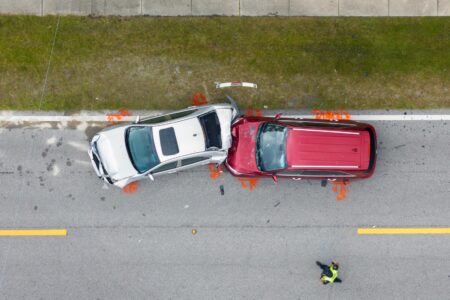

Lane movement tickets don’t announce themselves. One second, you’re merging on I-435, the next, there are lights in your mirror over a lane change you thought was perfectly fine. It’s one of the more frustrating citations to receive because it often feels completely subjective — the officer saw something you didn’t think was a problem, and now you’re dealing with the paperwork.
But these tickets carry real consequences, and knowing what you’re actually facing changes how you respond to them.
What Missouri Law Says About Lane Movement
Missouri law under RSMo § 304.015 requires drivers to stay within a single marked lane and only move from it when the move can be made safely. That’s the foundation. Two things have to happen for a lane change to be legal — it must be safe, and it must be signaled.
Both requirements are independent. Signaling without checking your blind spot doesn’t protect you legally. Checking your blind spot and making the move cleanly without signaling still violates the statute. Officers write citations for either failure, and they don’t need both to be present.
The safety standard means the adjacent lane must be genuinely clear before you enter it. Vehicles already in that lane have the right of way. The driver changing lanes carries the legal obligation to verify the path before committing. If a collision follows, fault defaults to the driver who changed lanes unless specific evidence shows the other driver was also doing something unlawful.
The Lane Movement Violations That Come Up Most Often
Unsignaled lane changes are the most common citation in this category. Drivers who check mirrors and make clean moves without using a turn signal get cited for this regularly — particularly on highways where officers watch lane discipline closely. The signal requirement isn’t optional on interstates, and Kansas City officers on I-70 and I-435 enforce it.
Cutting across multiple lanes at once generates its own separate problem. Moving from the far left lane to an exit ramp in a single sweep — crossing two or three lanes without pausing — is improper lane movement regardless of how much space existed in each lane individually. Each movement needs to be its own safe, signaled action.
Weaving between lanes without a clear purpose gets cited as both improper lane movement and sometimes reckless driving, depending on the speed and frequency involved. What feels like efficient navigation through traffic to the driver often looks like erratic behavior from an officer’s perspective.
Construction zones create a specific category of these violations. Lane boundaries shift. Temporary markings replace permanent ones. Drivers who navigate the same route daily suddenly encounter an unfamiliar configuration and make lane choices that don’t match what’s posted. Missouri doubles fines for moving violations in active construction zones — a citation that normally runs $150 can reach $300 or more depending on where it happened.
What the Ticket Actually Does to You
An improper lane movement citation is a moving violation in Missouri. Two points on your license. Fines typically between $100 and $200 before court costs. Manageable in isolation — less so in context.
Missouri suspends licenses at eight points within 18 months. If you’re already carrying points from a prior speeding ticket or other violation, two more can push you toward that threshold faster than feels comfortable. Insurance companies check your record at renewal — a rate increase that holds across two or three policy terms typically costs more than the fine itself. That math is worth doing before you decide to pay is the easier path.
If the lane movement caused an accident with injuries, the stakes shift considerably. Reckless driving charges and civil liability open up simultaneously. What started as a citation becomes a genuinely serious legal problem faster than most people expect.
A Missouri traffic ticket lawyer can help you understand what you’re actually dealing with before anything compounds further.
How Speeding Ticket KC Handles These Cases
Speeding Ticket KC is a recognized law firm in Kansas City, Missouri. They handle traffic violations and related defense matters — including improper lane movement citations — for drivers who want real options rather than just a payment envelope.
Their attorneys review each case on its own facts. What exactly was cited? What did the officer observe? Is there dashcam footage, road layout evidence, or witness accounts that challenge the version in the report? What realistic outcomes exist — reduction, dismissal, or a negotiated result that keeps points off your record? No templates, no assumptions. Each case gets read on what it actually contains.
Questions People Actually Ask
Do I have to signal for every lane change in Missouri?
Yes. Missouri law requires a signal before every lane change on public roads — not just when it feels necessary or when traffic is heavy. The signal has to be given with enough advance notice to communicate intent before the move begins, not during it. A blinker activated the same moment you’re crossing into the next lane doesn’t satisfy the requirement legally. Officers enforce this on highways and in construction zones where lane discipline matters most, and the citation is the same whether or not the move itself was safe.
Can I challenge an improper lane movement ticket?
Yes — and it’s worth exploring before paying. These citations come from officer’s interpretation of what they observed, which creates room to push back. Dashcam footage showing the lane change was properly signaled and safely executed, road condition evidence, ambiguous lane markings, witness accounts that contradict the report — all of these feed into a viable defense. Even when full dismissal isn’t realistic, reducing the charge to a non-moving violation removes the points entirely. That outcome alone changes the insurance picture considerably.
What if the other driver accelerates when I change lanes?
This happens all the time and is a valid component of fault analysis. Missouri’s comparative fault system means that more than one person can be responsible for an incident. If the other driver pulled into a space that was clear when you started the maneuver, then their actions make them partly at blame. It doesn’t immediately clear you of liability as the lane-changing motorist, but it can lower your percentage of guilt in the citation and any civil action . A lawyer can tell you if that argument would apply to your case.
Are fines for lane infractions in construction zones steeper?
Yes. Missouri law doubles the punishment for traffic offenses in active construction zones when personnel are present. A lane movement ticket, typically approximately $150, can be $300 or more, depending on the zone. Most drivers don’t find out the amount until they receive the citation. If the infringement was in a marked construction zone, that alone makes it more financially worthwhile to contest it.
What do I do immediately once I obtain this citation?
Don’t pay automatically – payment is a legal admission, and points follow instantly. Write it all down while it is fresh: the layout of the road, the configuration of the lanes, what you signaled, when you signaled, the circumstances of the road, and what the officer said. Save dashcam videos before they get overwritten. Talk to a lawyer before your court date. The more deadlines you pass, the fewer options you have. Knowing what’s realistically available early allows you room to respond with strategy rather than just reacting to what’s happening.