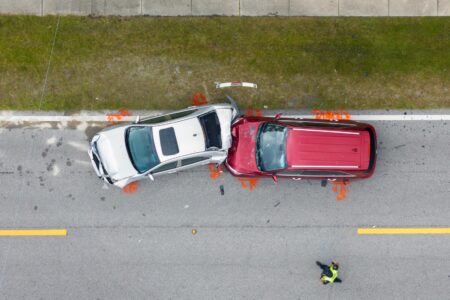

Lane changes happen dozens of times on any given commute. You check your mirror, signal, move over — usually without incident. But Kansas City officers write lane change violations regularly, and the drivers receiving them almost always feel the citation was unfair. Maybe the lane change was clean. Maybe the signal was on. Maybe the other driver sped up at the last second.
Feeling like you did nothing wrong and being able to prove it are two different things. That gap is where these cases get interesting.
What Missouri Law Requires for Lane Changes
Missouri law under RSMo § 304.015 sets the standard. A driver can only change lanes when it can be done safely — and must signal before making the move. That’s the core of it. Two requirements: safety and signaling. Both matter independently. Signaling without checking your blind spot doesn’t protect you. Checking your blind spot without signaling doesn’t either.
The safety requirement means you need a clear gap in the adjacent lane before moving into it. Not almost clear — actually clear. Vehicles in that lane have the right of way. The driver changing lanes carries the legal obligation to verify the path before committing to the move. If a collision follows, fault defaults to the driver who changed lanes unless there’s specific evidence that the other driver did something unlawful.
Signaling requirements under Missouri law specify a signal must be given within a reasonable distance before the lane change — generally at least 100 feet on a highway. A blinker activated simultaneously with the lane change doesn’t satisfy the requirement. The signal is meant to communicate intent before the move, not announce it mid-execution.
Where Lane Change Violations Happen Most in Kansas City
Highway interchanges generate the most citations. The I-70 and I-435 interchange, the merge from US-71 onto I-435, the pinch points around downtown where multiple highway entrances funnel traffic together — these are where drivers make rapid lane changes under pressure and officers watch closely.
Construction zones are their own category. Lanes shift. Markings get confusing. Drivers who’ve driven the same stretch for years suddenly find the lane configuration different from what they expect. Missouri doubles fines for moving violations in active construction zones when workers are present, which means a lane change citation that normally runs $150 can land at $300 or more, depending on where it happened.
Multi-lane city roads — Metcalf Avenue, State Line Road, 39th Street corridor — generate citations from drivers cutting across multiple lanes at once. That’s a specific version of improper lane use that carries its own problems beyond just the basic failure to signal.
What the Ticket Actually Costs You
A lane change violation is a moving violation. Two points on your Missouri license. Fines typically between $100 and $200 before court costs. Manageable — until you factor in the bigger picture.
Missouri suspends licenses at eight points within 18 months. If you’re carrying points from a prior violation, two more can push you closer to that line than feels comfortable. Insurance companies review your record at renewal — a rate increase compounding over two or three years frequently costs more than the original fine. Paying the ticket feels like the simple path. The financial tail it leaves behind often isn’t.
If the lane change caused an accident, the legal picture shifts significantly. Property damage, injuries, civil liability — all of it flows from the initial determination of fault. And that citation becomes evidence in any claim that follows. Fighting it, or at a minimum negotiating a reduction, carries real value beyond just the points.
A Missouri traffic ticket lawyer can help you understand what you’re actually dealing with and where realistic options exist.
Your Defense Options — They’re More Real Than You Think
Here’s what a lot of drivers don’t realize. Lane change citations are built on officer observation, which means they can be challenged. Dashcam footage is the most powerful tool — if your camera captures the lane change, it either supports or contradicts the officer’s account directly. That footage can change the outcome of the case entirely.
Witness accounts matter too. Other drivers who observed the incident, passengers in your vehicle, or bystanders who saw what happened — their accounts feed into whether the citation holds up.
Road conditions, lane marking quality, construction zone configuration changes, and signal timing at intersections can all contribute to a defense in the right circumstances. A lawyer reviews all of it, not just the citation itself, and identifies which arguments have realistic traction for your specific situation.
How Speeding Ticket KC Handles These Cases
Speeding Ticket KC is a well-known law firm in Kansas City, Missouri. They handle traffic violations and related defense matters — including lane change citations — for drivers who want real options rather than just an envelope to mail in.
Their attorneys look at each case on its own facts. What exactly was cited? What did the officer observe? What evidence exists that challenges the account? What realistic outcomes are available — reduction, dismissal, a negotiated result that keeps points off your record? No cookie-cutter approach. Each case gets read on what it actually contains.
Questions People Actually Ask
Do I have to signal for every lane change in Missouri?
Yes. Missouri law requires a signal before every lane change — not just when you feel like it or when traffic is heavy. The signal must be given with enough advance notice to communicate your intent before the move, not during it. A blinker activated at the same moment you’re crossing the line doesn’t satisfy the requirement. Officers enforce this, particularly on highways and in construction zones where lane discipline is tighter.
Can I fight a lane change ticket?
Yes — and dashcam footage is your most valuable asset if you have it. These citations come from officer’s interpretation of what they observed, which creates room to challenge the account. A lawyer reviews available footage, road conditions, witness accounts, and the specific details of what was documented. Even when full dismissal isn’t realistic, reducing the charge to a non-moving violation removes the points entirely and changes the insurance picture considerably.
What if the other driver sped up when I was changing lanes?
This happens more often than people realize, and it is a relevant consideration in fault analysis. Missouri has the “comparative fault” system for assigning fault after an accident. If the other driver accelerated to fill a space that was empty when you started to move, that assigns some of the blame to them. It doesn’t automatically make you not liable as the lane-changing motorist, but it can lower your percentage of culpability in both the citation and in any civil suit. A lawyer can tell you how that reasoning relates to your individual case.
Are the penalties for a lane change twofold in a construction zone?
Yes, Missouri doubles the penalties for a moving offense if workers are present in an active construction zone. Depending on the zone, a lane change citation that usually costs $150 can end up costing $300 or more. Most drivers don’t realize until they see the fine on the ticket. It is much more financially effective to fight the citation if the infringement took place in a defined construction zone.
So what do I do after I get cited?
Don’t pay automatically, that’s lawful admittance, and you get instant points. Write everything down while it is fresh – road conditions, lane design, what you signaled and when, what the officer said, any witnesses in the vicinity. Save the dashcam footage before it is overwritten. Then see a lawyer before you go to court. Deadline pressures constrain options. But if you have a good sense early on of what is truly accessible, you have room to adapt strategically rather than reactively.