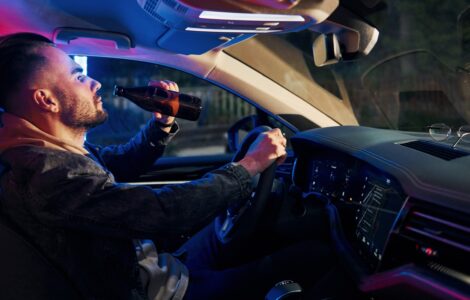
If you’re renting a car in Europe this year, Poland is an increasingly common stop, whether for business, a family visit or as part of a longer trip. The roads are good and the rules are broadly familiar. What isn’t familiar is how quickly a routine traffic stop can turn into something more serious, and how different the alcohol rules are from Missouri or Kansas.
Here’s what’s worth knowing before you get behind the wheel.
The alcohol limit is far lower than you think
In the United States the standard limit is 0.08% BAC. Poland works in per mille, and the thresholds are:
- 0.2‰ to 0.5‰ (roughly 0.02% to 0.05% BAC) is “after use of alcohol”, which is an offence in the misdemeanour category.
- Above 0.5‰ (roughly 0.05% BAC) is “a state of intoxication”, and that is a crime, not a traffic ticket.
The practical consequence: a single beer with dinner can put an average adult near or over the lower threshold. A level that would be legal to drive on in most of the US is prosecutable in Poland, and a level barely over the US limit is squarely criminal there.
“Criminal” means criminal
Driving a motor vehicle while intoxicated falls under Article 178a of the Polish Criminal Code. It carries a penalty of up to three years’ imprisonment, a mandatory driving ban of at least three years, and a mandatory payment of at least 5,000 z?oty (roughly $1,350) to a state fund for crime victims.
Since 2024 there is a further measure that surprises visitors most: at a reading of 1.5‰ or above, forfeiture of the vehicle is provided for. Where the driver isn’t the sole owner, as with a rental car, a monetary equivalent is ordered instead, which can run to substantial sums.
A conviction also creates a criminal record in Poland, which can surface later in visa applications and background checks in other countries.
Roadside fines versus court
Minor matters are usually dealt with by an on-the-spot fine, which the officer offers and you can accept or refuse. Accepting is quick and ends the matter. Refusing sends the case to a court, which is slower but is sometimes the better option if the facts are disputed.
The decision matters more than it looks. Accepting a fine is an admission, and for some offences it carries consequences beyond the money, including a driving ban. If you don’t understand what you’re accepting, it’s worth asking for the matter to go to court rather than signing to make it go away.
Leaving the country doesn’t end the case
This is the point most visitors get wrong. Proceedings continue after you fly home. Correspondence goes to the address on file, deadlines run from the date a letter is served rather than the date you read it, and a case can be decided in your absence.
An unresolved matter can also follow you back. Within the EU, judgments and financial penalties are recognised across member states, and an outstanding driving ban can affect your ability to drive there in future. If you’re facing something serious, arranging Polish representation before you leave is far easier than sorting it out afterwards from four thousand miles away.
Your rights at the roadside and afterwards
Three things are worth knowing:
- If you don’t speak Polish well enough to follow the proceedings, you have the right to free interpretation in criminal matters. Use it. Signing documents you can’t read is how people end up agreeing to things they didn’t intend.
- You can decline to give explanations without that being held against you.
- If detained, you have the right to contact a lawyer promptly, and, as a foreign national, to have your consulate notified under the Vienna Convention on Consular Relations. The US embassy can’t intervene in the case, but consular notification is your entitlement.
Practical differences that catch Americans out
- Headlights on at all times, day and night, year-round.
- Zero tolerance in practice for phone use without a hands-free kit.
- Speed cameras are widespread, and rental companies pass fines on to you with an administrative charge.
- An International Driving Permit is recommended alongside your state licence, and cheap to obtain before you travel.
- Alcohol testing is routine, not reserved for suspicious driving. Roadside checks of every car in a line are normal, and refusing a breath test is itself an offence.
If something does go wrong
Take the paperwork seriously, note the date anything was handed to you or served, and don’t assume a matter is closed because you left the country. For anything in the criminal category, get advice before agreeing to a resolution, because the fast options that seem attractive at the time carry consequences that last years.
English-speaking lawyers handle these cases throughout Poland, and much of the work can be done remotely once you’re home. Criminal defence for foreign nationals in Poland sets out how the process works from a foreign driver’s perspective, from the roadside stop through to appeal.
Most trips involve none of this. But the gap between a US traffic ticket and a Polish criminal charge is wider than most visitors expect, and knowing where the line sits is the difference between an inconvenience and a problem that follows you home.
This article is general information about Polish law, not legal advice, and it does not create a lawyer-client relationship. Rules and penalties change, and individual cases turn on their own facts.