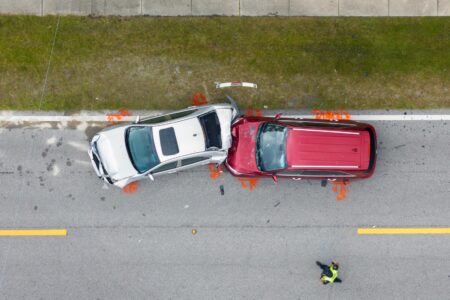

Sidewalks don’t usually register as a legal concern for drivers. They’re just there — that strip of concrete between the road and everything else, used by pedestrians while drivers focus on traffic. Most drivers pass hundreds of sidewalks every week without a second thought. Until they drive on one. And someone sees it.
Sidewalk driving violations in Kansas City catch people off guard in a way that most traffic citations don’t. The incident often feels so brief, so slow, so obviously harmless that the idea of a legal consequence seems wildly disproportionate. But Missouri law and Kansas City municipal code don’t grade violations on how harmless they felt from inside the vehicle. They grade them on what the violation represents — and what it puts at risk.
What Makes Sidewalk Driving a Legal Issue at All
The short answer: sidewalks aren’t roads, and vehicles are legally required to stay on roads.
Missouri traffic law requires vehicles to be operated on designated roadways. A sidewalk is specifically excluded from that category. It’s pedestrian infrastructure — built, maintained, and legally designated as a space for people on foot. When a vehicle enters that space, it’s operating outside its legally defined zone regardless of how briefly, slowly, or inadvertently it happened.
Kansas City municipal code Section 70-405 makes this explicit with a direct prohibition on operating vehicles on sidewalks. This city ordinance sits alongside the state statute, giving officers the option to cite under local code, state law, or both. How that choice gets made affects which court handles the case, what the fine schedule looks like, and what the point value is. Those distinctions matter when deciding how to respond.
The underlying logic is straightforward. Sidewalks are spaces where pedestrians have a reasonable expectation of safety from vehicles. That expectation doesn’t depend on whether a pedestrian is actually present at the moment of the crossing. The law protects the space, not just the people who happen to be using it at a given moment.
The Common Violations Kansas City Officers Actually Cite
Sidewalk violations in Kansas City cluster around recognizable situations. Understanding them matters both for context and for what kind of defense is realistic given the specific circumstances.
Parking lot access crossings are the most frequent source. Older commercial properties throughout Kansas City — in the Crossroads, along the 39th Street corridor, in Northeast neighborhoods, around the River Market area — have entrances that require crossing the public sidewalk to access the lot. Drivers use these entrances routinely, often having done so dozens of times without incident. When an officer is present and observing, that routine access produces a citation. Frequency and familiarity don’t create a legal exemption.
Traffic queue shortcuts are the second major category. A driver sitting in a backed-up line spots what looks like an opening — sidewalk space, a wide apron, a gap near the curb — and uses it to advance past stopped traffic. The move takes ten seconds. The citation is real. Officers treat deliberate sidewalk use for traffic avoidance differently than accidental incursions, and that characterization affects how the case gets handled.
Distracted parking maneuvers create genuine mistakes. A backing maneuver that swings wider than expected. A pull-forward attempt in a tight lot that overshoots the space. A driver who doesn’t fully register where the roadway ended while approaching a parking spot. These incidents feel accidental because they are — but accidental still produces a citation when an officer observes it.
Construction zone boundary confusion generates some of the most defensible violations. Kansas City’s active road projects regularly create situations where temporary markings replace permanent ones, where the edge of the travel lane isn’t clearly delineated, and where a driver following imperfect construction signage ends up on a sidewalk without clear awareness. This context matters legally in a way that simple inattention doesn’t.
Event-related congestion around venues like T-Mobile Center or GEHA Field during games and concerts pushes drivers into situations they don’t normally encounter. Unfamiliar streets, unusual traffic patterns, and general congestion lead to maneuvers that cross into sidewalk territory. Officers working event traffic know what to watch for.
How the Citation Connects to Pedestrian Safety in Legal Terms
Here’s something courts understand that drivers sometimes miss: the seriousness of a sidewalk violation isn’t just about what happened. It’s about what could have happened — and the law is calibrated to protect against the possibility, not just the actual outcome.
Pedestrians use sidewalks with the assumption that vehicles won’t enter that space. Children walking to school, elderly residents using a walker, someone pushing a stroller — these are the people the law is designed to protect. When a vehicle enters that space, even briefly, it violates the guarantee those pedestrians rely on. Courts recognize this, and it shapes how judges and prosecutors approach these cases even when no pedestrian was present at the moment of the violation.
The presence of a pedestrian during a sidewalk incursion is a significant escalating factor — not just in terms of how the citation might be characterized, but in terms of what additional charges might be warranted. Reckless endangerment becomes possible when someone’s safety was directly threatened. That’s a misdemeanor, not a traffic infraction, and it carries a different category of consequences entirely.
This is why sidewalk citations deserve a more considered response than a routine fine payment. The underlying legal framework takes them seriously, and the options available to a driver who responds thoughtfully are meaningfully different from those available to one who pays and moves on.
Points, Fines, and What Actually Follows From a Conviction
Two to four points on a Missouri license, depending on how the citation is written and which statute or ordinance applies. Against Missouri’s eight-point suspension threshold within 18 months, that range represents a significant portion of the margin — particularly for any driver who’s had other violations recently.
Fines vary based on the specific charge and the court handling the case. Municipal ordinance fines run on a different schedule than state statute fines. Court costs add on top regardless. The fine amount, though, is typically the smallest part of the financial picture.
Insurance is where the long-term cost accumulates. Moving violation convictions appear at renewal and prompt risk-based premium adjustments. Sidewalk violations specifically signal imprecise vehicle control — not a dramatic red flag, but a flag nonetheless. Increases of 20 to 30 percent for a single moving violation aren’t unusual, and they persist across multiple renewal cycles. Viewed across three years of renewals, the total cost of a conviction paid without exploring options is frequently several times the original fine.
Paying immediately makes all of this permanent. Once paid, it’s a conviction — on the record, counted in points, visible to insurers, not subject to any further review. A Missouri traffic ticket lawyer at Speeding Ticket KC reviews sidewalk citations before any payment decision gets made. The firm handles both city ordinance citations and state statute violations throughout Kansas City, understands how these cases move through local courts, and knows what options realistically exist for reduction or dismissal in a driver’s specific situation.
When a Sidewalk Incident Becomes More Complicated
Most sidewalk citations resolve in traffic court. Points, fine, moving violation record entry — significant, but manageable with the right legal response.
Pedestrian presence during the incident is the most serious complicating factor. Even without contact, a pedestrian on or near the sidewalk when the vehicle entered creates grounds for a more serious charge. Officers characterize these situations differently, and prosecutors respond accordingly.
Property damage adds civil exposure that runs parallel to the traffic citation. A vehicle that damages street furniture, a planter, a bicycle, signage, or any other property during a sidewalk incursion creates liability issues that need to be navigated carefully alongside the traffic charge — not addressed impulsively in ways that inadvertently make either situation worse.
And if the driver continued after causing either pedestrian endangerment or property damage without stopping to address it, hit-and-run implications can follow. What reads as a minor routing mistake at the moment becomes a significantly more complex legal situation requiring a correspondingly serious legal response.
Questions Kansas City Drivers Ask About Sidewalk Citations
1. Does it matter that the sidewalk was completely empty when I crossed it?
The absence of pedestrians affects severity assessment and negotiation room, but not whether the violation occurred. Missouri law protects sidewalk space regardless of current occupancy. What the absence of pedestrians does do is remove the most serious escalating factor — reckless endangerment — giving courts and prosecutors more flexibility in how they resolve the case. For first-time offenders in clear no-pedestrian situations, that context supports stronger arguments for reduction to a non-moving violation that carries no points.
2. I was just crossing the sidewalk briefly to access a parking lot. Is that really a violation?
It is — even if it’s the normal way drivers access that lot, and even if you’ve done it many times before. Common practice doesn’t create legal permission. What it can do is support a contextual argument: that the crossing was brief, slow, incidental to legitimate access, and consistent with how the lot entrance is generally used. An attorney can frame those circumstances effectively in negotiations, particularly for first-time offenders with no prior history of similar violations.
3. Can a sidewalk citation be reduced to a non-moving violation?
Yes, in appropriate circumstances. Non-moving violation reductions eliminate the point impact and the insurance signal completely — the most practically significant consequences of a moving violation citation. Kansas City courts allow these reductions for the right cases, and first-time offenders with clean driving histories have realistic access to them through negotiation. Speeding Ticket KC handles these negotiations and gives clients an honest assessment of what’s achievable based on the actual facts of their situation.
4. What if the sidewalk boundary wasn’t clearly marked where it happened?
Unclear boundary markings are a legitimate defense factor — particularly in construction zones, older commercial areas, or locations where road and pedestrian surfaces merge without obvious visual distinction. If the boundary was genuinely ambiguous, photograph the site immediately: the approach angle, the surface markings (or their absence), and anything relevant to how a driver could have reasonably perceived the boundary. That documentation gives an attorney something concrete to work with rather than a general claim of confusion.
5. How soon after receiving a sidewalk citation do I need to act?
Sooner than most drivers think. Court dates in Kansas City arrive faster than people typically expect, and response deadlines are real — missing one adds failure-to-appear consequences on top of the original violation. Speeding Ticket KC recommends reaching out within days of receiving any citation, not weeks. Early contact means more time to review the documentation, understand the specific charges, and pursue the best available outcome before any deadlines close off options permanently.
Final Words
Sidewalk violations are easy to dismiss as overreach for something that felt completely harmless. The points, the insurance adjustments, and the potential for escalation tell a different story. Understanding what you’re actually facing — and making a deliberate decision about how to respond before paying anything — is what determines whether this brief incident follows your driving record for years or gets resolved without leaving a lasting mark.