
DWI charges in Kansas City carry a weight that most other traffic situations simply don’t. They’re criminal charges — not traffic citations with points attached. They affect your license, your record, your insurance, and depending on what happened during the stop and what prior history exists, potentially your freedom. And they move through the legal system on a timeline that rewards early action and penalizes delay.
Understanding what Missouri’s DWI law actually covers — not just the general concept, but the specific legal standards and how they get applied — changes both how drivers approach situations where impairment is a concern and how they respond when a charge arrives.
What Missouri’s DWI Law Actually Says
It’s more complex than the “don’t drink and drive” message most have – and the complex nature is important.
Under Missouri Revised Statutes Section 577.010, a person commits the crime of driving while intoxicated if he/she operates a motor vehicle while inebriated or under the influence of a substance. The act includes alcohol, prohibited substances, and any other substance that affects the capacity of a motorist to operate a vehicle safely. Missouri’s per se legal limit for standard drivers is .08% blood alcohol concentration, meaning that a BAC at or above that level is proof of intoxication as a matter of law, without any further evidence of impaired driving behavior.
For commercial drivers, the limit is .04%. Under Missouri’s zero tolerance regulations, any detectable alcohol can establish legal exposure under the state’s young driver laws for drivers under the age of 21.
But here’s the problem most folks don’t know – the BAC limit isn’t the only way to get hit with a DWI charge. A driver with less than .08% can be charged with DWI if the evidence reveals that their ability to drive was affected. The officer will note the conduct of the driving and manner at the stop . All of these things are proof of impairment . This does not have to be at the per se BAC level. Field sobriety test results and observation evidence.
How DWI Cases Start in Kansas City
The stop is where everything begins — and how the stop proceeds shapes much of what follows.
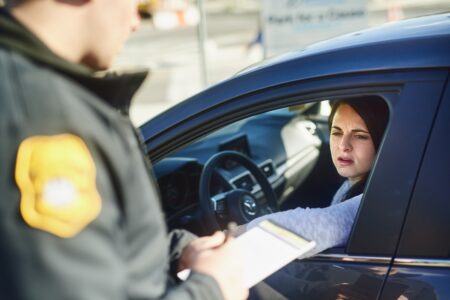
Most DWI cases start with a traffic stop for another reason. Speeding. A lane violation. A broken taillight. Erratic speed or weaving. The officer approaches, observes the driver, detects indicators of potential impairment, and the stop transitions from a traffic contact to a DWI investigation. That transition happens quickly, and the decisions made at the roadside in those first minutes carry significant legal weight throughout everything that follows.
Officers are trained to conduct standardized field sobriety tests — the walk and turn, the one-leg stand, the horizontal gaze nystagmus test — and to document what they observe during each. How those tests were administered, under what conditions, and whether the results were accurately documented and interpreted all become relevant when the case gets examined by an attorney. These tests aren’t infallible. Environmental conditions, physical limitations, nerves, and test administration issues can all affect performance and interpretation.
Chemical testing — breathalyzer or blood draw — produces the BAC measurement that either meets or doesn’t meet the per se threshold. Missouri’s implied consent law means that driving on Missouri roads constitutes consent to chemical testing when lawfully requested after a DWI arrest. Refusing the test triggers an automatic license revocation that operates independently of what happens in criminal court.
What a DWI Conviction Actually Costs
The penalties vary significantly based on prior history — and Missouri’s lookback period is long.
A first DWI offense in Missouri is a Class B misdemeanor — up to six months in jail, fines, potential probation, and mandatory participation in a substance abuse program. License suspension follows. A second offense within five years escalates penalties significantly. A third or subsequent offense can be charged as a felony.
Beyond the criminal penalties, the collateral consequences compound over time. Insurance companies access conviction records and respond with surcharges that persist for years. Some professional licenses in Missouri require reporting DWI convictions to licensing authorities. CDL holders face federal disqualification consequences that operate separately from state penalties — a first DWI can result in one year of CDL disqualification, and certain situations result in lifetime disqualification.
The license implications also involve two separate tracks that require separate attention: the criminal case and the administrative license revocation that begins automatically upon arrest. Missing the deadline to request a hearing on the administrative revocation results in license loss regardless of what happens in criminal court.
Why Early Legal Involvement Matters
The timeline on DWI cases in Kansas City moves quickly — and early involvement by an attorney changes what’s possible.
The administrative hearing deadline is short. Evidence gets preserved or disappears. The officer’s specific account and the dashcam and body camera footage need to be requested and reviewed before they’re no longer available. Statements made without legal guidance become part of the prosecution’s case. These are all situations where delay consistently produces worse outcomes than acting promptly.
A Missouri traffic ticket lawyer who handles DWI cases in Kansas City courts understands both the criminal defense dimensions and the administrative license revocation track that runs parallel to the criminal case. Speeding Ticket KC works with Kansas City drivers facing DWI charges from the moment of the arrest through final resolution — addressing both tracks simultaneously to produce the best available outcome across all dimensions.
Questions Drivers Ask About Missouri DWI Laws
1. Can I be charged with DWI in Missouri if my BAC is below .08%?
Yes — and this surprises people. Missouri’s per se limit of .08% establishes intoxication as a matter of law at that level, but the DWI statute also covers operating while in an “intoxicated condition” regardless of measured BAC. If the officer’s observations, field sobriety test performance, and other evidence support a finding of impairment, a charge can proceed even with a BAC below the per se threshold. Understanding this distinction matters both for how drivers think about situations involving alcohol and for how DWI cases get defended.
2. What happens if I refuse chemical testing in Missouri?
Refusing chemical testing after a lawful DWI arrest triggers an automatic license revocation under Missouri’s implied consent law. That revocation operates on an administrative track separate from the criminal case — meaning it can happen even if criminal charges are later dismissed or result in acquittal. The revocation period for first-time refusal is typically one year. Whether refusing chemical testing is strategically beneficial in a specific situation is a question an attorney can answer given the particular circumstances — it’s not a universally good or bad decision.
3. How long does a DWI stay on my Missouri driving record?
Missouri’s lookback period for prior DWI offenses is five years for most purposes — meaning a prior conviction within five years can result in enhanced penalties on a subsequent charge. For some purposes, including certain professional licensing and background check contexts, DWI convictions can appear for significantly longer periods. The insurance implications typically persist for three to five years after a conviction, during which insurers apply surcharges to premiums that compound the financial consequences beyond the original fine.
4. What should I do at the scene if I’m stopped on suspicion of DWI?
Provide your license, registration, and insurance — Missouri law requires this. Be respectful and cooperative with law enforcement. Beyond those immediate obligations, you have the right to remain silent and the right to an attorney. You can decline to answer questions about where you’ve been or what you’ve consumed without creating additional legal problems. Field sobriety tests in Missouri are not legally mandatory for non-commercial drivers — whether to participate involves considerations an attorney can advise on. Chemical testing after lawful arrest is a different question, given implied consent consequences for refusal.
5. How important is it to contact a lawyer immediately after a DWI arrest?
Very — and the importance is time-sensitive in specific ways. The administrative hearing deadline to contest license revocation is short — missing it results in automatic license loss. Evidence from the stop, including video footage, is more accessible immediately after the incident than later. Statements made without legal guidance become part of the case. Speeding Ticket KC works with Kansas City drivers from the immediate aftermath of DWI arrests through final resolution — addressing both the criminal and administrative dimensions simultaneously in ways that produce the best outcomes available given the specific circumstances.