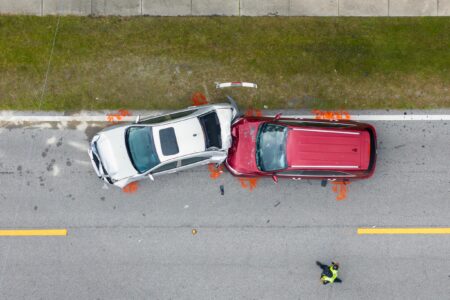

Navigating the immediate aftermath of a motor vehicle collision in the Kansas City metropolitan area is an incredibly stressful experience. In the moments following a crash, drivers must quickly check for injuries, move vehicles out of active traffic corridors if possible, and wait for emergency responders to arrive at the scene. When local police or state highway patrol officers conclude their initial on-scene investigation, they frequently issue a traffic citation to the driver they believe precipitated the incident.
For many motorists, receiving a speeding ticket or a citation for failing to yield at a Kansas City intersection feels like a secondary, administrative issue that can be handled later by simply paying a fine or appearing in a local municipal court. However, this administrative citation carries massive legal weight that extends far beyond a simple fine or points on a driving record. In reality, a traffic ticket issued at the scene of a crash fundamentally alters the civil liability dynamics of the entire accident. While an administrative citation can impact your driving record, it also acts as a foundational piece of evidence in a civil claim, making it critical to consult an experienced Kansas City Personal injury lawyer to protect your rights if the incident resulted in physical injuries.
1. The Legal Concept of Negligence Per Se
To understand exactly why a traffic citation is so damaging in a civil lawsuit, it is necessary to examine how courts determine fault in an auto accident claim. In a standard personal injury case, the injured party must prove that the at-fault driver was negligent—meaning they failed to operate their vehicle with the level of care that a reasonably prudent person would use under similar circumstances. Proving negligence typically requires analyzing physical evidence, witness statements, and accident reconstruction data.
However, when a driver violates a traffic statute designed to protect public safety—such as exceeding a posted speed limit, running a red light, or driving under the influence—the legal framework changes dramatically. Under both Missouri and Kansas civil laws, this scenario invokes a legal doctrine known as negligence per se. Under this doctrine, if a driver violates a safety law and that violation directly causes an accident, the driver is automatically considered negligent as a matter of law. The injured party no longer needs to spend months proving that the driver’s actions were unreasonable; the traffic ticket itself serves as definitive proof that a safety standard was breached, instantly shifting the focus of the case entirely toward quantifying the financial value of the medical damages.
2. The Trap of Pleading Guilty to a Municipal Ticket
A common tactical error made by Kansas City drivers following a collision is simply paying their traffic citation online or through a mail-in portal to avoid a physical appearance at a local municipal court, such as the Kansas City Municipal Court or the Independence Municipal Court.
What many motorists fail to realize is that paying a fine directly to the court without contesting the charge constitutes a formal, legal admission of guilt to the infraction. This admission creates a permanent public record that can be introduced as powerful evidence by the other driver’s legal team during a subsequent civil insurance claim or personal injury lawsuit. By pleading guilty to the initial speeding violation, a driver inadvertently strips their own insurance defense team of key arguments, making it incredibly easy for the opposing side to establish absolute civil liability for the crash and any subsequent injury claims.
3. Navigating Cross-Border Complexities in the Kansas City Metro
The geographic layout of the Kansas City metropolitan area adds an extra layer of complexity to traffic accident liability. Because the metro area straddles the state line between Missouri and Kansas, drivers routinely cross state borders during their daily commutes. If an accident occurs on the Kansas side of the metro (such as in Overland Park or Olathe) versus the Missouri side, entirely different statutory insurance frameworks apply.
- Missouri’s Pure Comparative Fault Model: Missouri utilizes a pure comparative fault system. If a driver receives a speeding ticket during an accident, a jury can assign them a specific percentage of blame for the crash. For example, if you are found to be 20% at fault due to excessive speed, your final financial recovery will be reduced by exactly 20%.
- Kansas’s Modified Comparative Fault System: Kansas enforces a modified comparative fault rule with a strict 50% threshold. If the evidence shows that a speeding violation makes a driver 50% or more responsible for the crash, they are completely barred from recovering any financial compensation from the other party.
Because a single traffic citation can completely shift these percentage calculations and dictate whether a driver can recover compensation at all, challenging the ticket in the appropriate local jurisdiction is vital to protecting the broader civil injury claim.
4. The Role of a Traffic Defense Strategy in Safeguarding Civil Rights
Because an uncontested traffic ticket can completely dismantle a driver’s civil defense, implementing a proactive traffic defense strategy immediately following a collision is essential. Working to get a citation dismissed, amended to a non-moving violation, or deferred through a diversion program changes how that infraction can be used against you in the future.
When a traffic defense attorney successfully negotiates a ticket down to a non-moving infraction—such as a defective equipment violation—the legal admission of moving negligence vanishes. The opposing driver’s insurance adjusters can no longer use the ticket as an open-and-shut proof of reckless driving or excessive speed. This protection keeps the civil claim focused on objective accident dynamics, allowing medical experts, vehicle damage reports, and witness statements to determine actual fault rather than allowing a single police officer’s on-scene citation to settle the matter automatically.
Conclusion
A traffic ticket issued after a Kansas City car accident is never just a minor administrative matter. It is a powerful legal document that can instantly dictate the outcome of a high-stakes personal injury claim or insurance settlement. By recognizing the dangers of negligence per se, avoiding the trap of premature online guilt admissions, and taking swift action to defend against municipal citations, drivers can successfully protect their records, isolate their liabilities, and ensure their long-term financial interests remain secure.