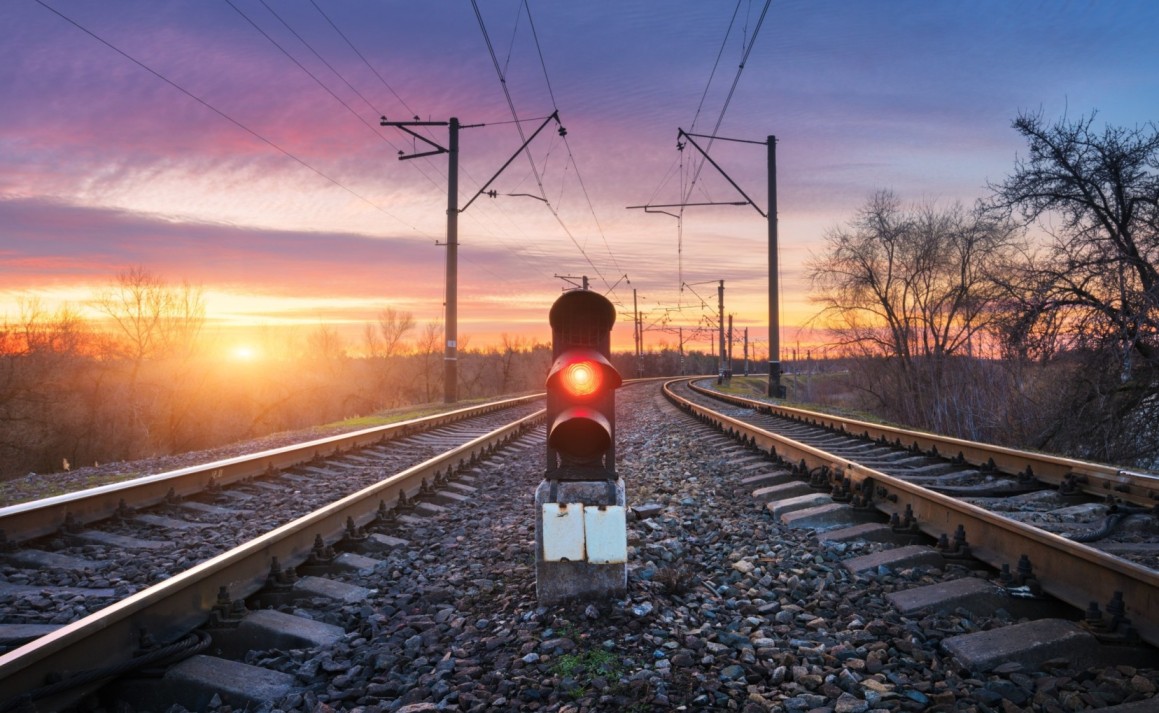
There’s a particular stretch of the morning commute that Kansas City drivers know by feel. You’re running a few minutes behind. The crossing lights haven’t been activated yet, and the gate is still up. You accelerate slightly to get through before anything changes — and then the bells start, and the lights flash, and you’re already past the line.
Or the gate was already down after a train cleared, but it wasn’t moving back up fast enough, so you went around it.
Or traffic backed up at a light ahead, and you pulled forward into the queue before realizing your car was now sitting directly on the tracks.
All three of these situations produce citations for failure to stop at a railroad crossing. And all three carry consequences that don’t match how routine the moment felt when it happened.
The Physics Argument That Makes This Law Non-Negotiable
Before getting into statutes and points and fines, it’s worth spending a moment on why this particular violation is treated so seriously.
A freight train traveling at 55 miles per hour needs more than a mile to stop. That’s not a figure from a safety brochure — it’s physics. Braking force against that much mass over that much momentum requires over 5,000 feet of track to bring it to a halt. A driver who enters a railroad crossing in front of an approaching train has, in any practical sense, no recovery option. The train isn’t going to stop in time. The signals exist precisely because by the time a driver can clearly see and assess a train, the gap to safely clear the crossing may have already closed.
Missouri law reflects this reality. The crossing statutes aren’t calibrated to the cost of a train delay or property damage. They’re calibrated to a scenario where a mistake produces catastrophic, irreversible consequences. Courts understand this context — which is why judges and prosecutors approach crossing violations differently than they approach ordinary moving violations.
What Missouri Law Requires at Railroad Crossings
RSMo § 304.030 through § 304.040 set out the specific requirements. Most drivers know the general idea — stop when the lights flash — but the specifics are where violations actually occur.
When crossing signals activate — lights flashing, bell ringing, gate descending or fully lowered — drivers must stop before reaching the nearest rail. Not at the gate. Before the rail itself. A driver who stops at the gate arm but then inches forward until their front wheels are on or past the rail has violated the statute, even if the gate never descended on their vehicle.
Stopping on the tracks is prohibited under all circumstances, including when no signals are active. This is what catches drivers in traffic backup situations. A light turns green ahead. A driver advances with surrounding traffic. Traffic stops before clearing the tracks. The driver is now sitting on active rails — and under Missouri law, they’re in violation regardless of whether any signals were flashing when they moved forward. The rule is simple: don’t enter a crossing unless you can fully clear it.
Navigating around a lowered gate is explicitly prohibited. Missouri doesn’t create exceptions based on the driver’s assessment of whether the gate is malfunctioning or whether the train has already passed. A lowered gate means stop and wait — period. If the gate appears stuck after a train clears, the legal response is to wait for it to rise, not to go around it.
The Kansas City Crossings That Produce the Most Violations
Kansas City isn’t just a city that happens to have railroad crossings. It’s a major national rail hub — freight lines running in every direction, through residential neighborhoods, across busy surface streets, and along industrial corridors throughout the metro.
The West Bottoms and the areas north of downtown see heavy, irregular freight traffic that doesn’t follow predictable patterns. Drivers who use these crossings daily sometimes develop a false sense of the train schedule. That familiarity produces the kind of judgment call that leads to citations.
Downtown crossings generate backup situations regularly. When signals activate while traffic is already queued at the crossing, vehicles that pulled forward with surrounding traffic may find themselves on the tracks when the gates start descending. This isn’t a rare edge case — it happens, and officers who respond to the scene write citations based on vehicle position.
Suburban crossings in Raytown, Independence, and Grandview carry higher-speed freight traffic. The visual gap that looks sufficient from 300 feet away closes within seconds at train speeds. Drivers who judge “there’s enough time” are sometimes simply wrong about the math.
What the Citation Costs — Beyond the Fine
Two to four points on a Missouri license, depending on how the citation is written and what specific violation is charged. Against Missouri’s eight-point license suspension threshold within 18 months, that’s meaningful — particularly for any driver who has prior violations already on their record.
Fines for crossing violations run higher than standard traffic infractions. Work zone or active-crew situations can produce enhanced penalty amounts. Court costs add to the base fine regardless of specific charge.
Insurance is where the long-term financial impact accumulates most significantly. Moving violation convictions appear at renewal. Carriers assess railroad crossing violations as indicators of serious risk behavior — not the same as a lane drift or an expired registration, but a signal that the driver made a decision in a high-stakes situation that suggests elevated risk. Premium increases of 20 to 30 percent at renewal aren’t unusual, and they persist across multiple renewal periods.
Paying the citation immediately feels like resolution. It’s permanent resolution — conviction on the record, points counted, insurance notified, no further review. That finality is worth pausing on before logging onto a payment portal.
A Missouri traffic ticket lawyer at Speeding Ticket KC reviews railroad crossing citations before any payment decision gets made. The firm handles these violations across Kansas City’s municipal and county courts, understands the specific statutes at issue, and knows where realistic options for reduction or challenge actually exist. Many clients resolve their cases without appearing in court at all — but that outcome requires acting before any deadlines close off the path.
When This Becomes More Serious Than a Traffic Citation
Most railroad crossing citations stay in traffic court. Fine, points, court appearance — significant but manageable.
Some don’t stay there.
A vehicle that made contact with a train, or that created a near-miss situation that resulted in emergency response, involves a different level of legal scrutiny. Reckless endangerment becomes possible when the behavior showed clear disregard for an obvious danger. If passengers were present, or if other motorists were affected, the exposure multiplies.
Commercial vehicle violations carry federal consequences alongside state ones. CMV operators who fail to stop at railroad crossings face federal reporting requirements and potential CDL consequences that operate independently of Missouri traffic court. For professional drivers, this is never a routine traffic matter — it’s a situation requiring legal attention that accounts for both state and federal dimensions.
Getting legal review early — before making statements about the incident and before any payment decision is finalized — is what preserves the most options.
Questions: Kansas City Drivers Ask After This Citation
1. I went around a stuck gate after the train cleared. Is that actually a violation?
Yes, under Missouri law. The statute doesn’t create exceptions based on the driver’s judgment about why the gate is in the down position. If the gate is lowered, compliance means waiting — not assessing whether it’s stuck and going around it. That said, documented gate malfunctions at crossings where no second train was present do factor into how prosecutors approach negotiations, particularly for first-time offenders with clean records. Document the situation immediately: time, location, photos of the gate position if accessible. That documentation gives an attorney something concrete to work with.
2. I was stopped on the tracks because traffic backed up. Is that a violation?
Yes — Missouri law requires drivers not to enter a crossing unless they can completely clear it. That obligation applies even in stopped urban traffic and even when the signal ahead was green when you moved forward. Courts understand that traffic backups happen, and that context can factor into negotiations for first-time violations. But the legal obligation exists independently of the traffic situation. An attorney can assess whether the specific circumstances of the backup support a mitigating argument that changes the outcome.
3. Are commercial driver penalties really different?
Significantly. Federal regulations require CMV operators to stop at all crossings regardless of signal status, open windows or doors, look both ways, and confirm clearance before proceeding. Violations trigger federal reporting and can affect CDL status independently of Missouri traffic court outcomes. The professional implications make immediate legal representation essential for commercial drivers — not optional.
4. Can a railroad crossing citation be reduced or dismissed?
In the right circumstances, yes. Cases where signal documentation is ambiguous, where the officer’s account has gaps, or where a first-time offender with a clean record is involved have realistic paths toward negotiated outcomes. Non-moving violation reductions eliminate the point impact and the insurance signal entirely. Speeding Ticket KC evaluates the specific facts honestly and tells clients what’s realistically achievable before any payment decision gets made.
5. How quickly do I need to act?
Quickly. Court dates arrive faster than people expect, and options narrow as deadlines approach. Missing a response deadline adds failure-to-appear consequences on top of the original violation. Speeding Ticket KC recommends reaching out within days of receiving any railroad crossing citation — not weeks. Early contact means more time to review the documentation, assess what happened, and pursue the best available outcome before any options close permanently.
Endnote
Railroad crossing laws exist because the physics of what happens when a vehicle and a train occupy the same space at the same time leaves no room for second chances. A citation from one of these situations deserves a response that accounts for both what’s at stake and what options still exist — because those options narrow with every day that passes without action.