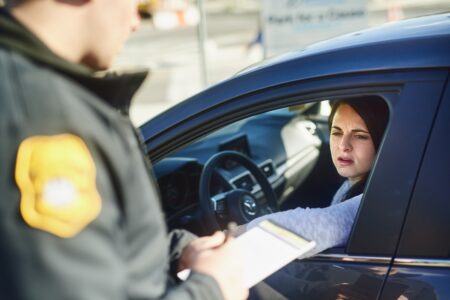

It happens faster than people expect. Blue and red lights appear in the mirror. The brain starts processing — is that for me? Where do I pull over? What did I even do? — and in those few seconds of hesitation, a traffic stop becomes something else entirely.
Some drivers panicked. Some genuinely didn’t see the signal right away. Some were in an unfamiliar area and kept moving while looking for somewhere safe to stop. And yes — some made a split-second decision they immediately regretted. Whatever the reason, the result is the same: a charge for eluding a police officer that carries consequences most people don’t see coming until they’re already in the middle of them.
This isn’t a speeding ticket. Not even close.
The First Thing You Need to Understand
Most traffic violations live in a specific, manageable category. You went too fast, an officer documented it, you pay a fine, points hit your license, insurance finds out at renewal. Uncomfortable, costly, but contained.
Eluding a police officer in Missouri doesn’t live in that category. RSMo § 575.150 governs this charge — and it’s a criminal statute, not a traffic ordinance. A conviction doesn’t just appear on your driving record. It appears on your criminal record. The one that employers check. The one that landlords see. The one that professional licensing boards review when you apply for a nursing license, a real estate license, a teaching certificate, a financial services registration.
That distinction matters more than most people realize until it’s too late to do anything about it.
At the misdemeanor level — the baseline, where the driver stopped relatively quickly without creating serious danger — it’s a Class A misdemeanor. Up to a year in jail. Real fines. A criminal conviction that follows a person for years. At the felony level — when the eluding involved excessive speed, endangered others, or resulted in injury — it becomes a Class D felony with potential prison time.
That’s a wide range. Where a specific situation lands within it depends on what actually happened, how long the driver kept going, what speeds were involved, and what the circumstances around the initial stop looked like.
Not Every Eluding Charge Looks Like a Police Chase
The word “eluding” conjures a specific image — high speeds, running red lights, a dramatic pursuit through city streets. And yes, those situations produce this charge. But they’re not the only ones.
A driver who genuinely didn’t notice the lights right away and traveled four blocks before pulling over may still face this charge depending on how the officer documents what happened. A driver who slowed but didn’t stop immediately — creeping forward while an officer’s lights were active — can face it too. The legal standard is willful flight or attempt to elude, but how that plays out in practice depends heavily on what gets written in the report.
Kansas City produces these situations in recognizable patterns. Highway stops on I-70 or I-435 where a driver kept going for an exit before stopping. Residential areas in Northeast Kansas City, Independence, or Raytown where a driver turned onto a side street before pulling over. Situations where someone with a warrant panicked and made a decision they knew was wrong the moment they made it.
The context of where it happened and how matters — not just morally, but legally. Eluding on a residential street near a school looks different to a prosecutor than a brief failure to stop immediately on an empty highway ramp at 11 pm.
What Actually Happens to Your Life After This Charge
Here’s the part people underestimate. They’re thinking about the court date, the fine, the points on the license. They’re not thinking about the background check six months from now when they apply for a new job.
A criminal conviction under RSMo § 575.150 shows up in background checks. Not driving record checks — criminal background checks. The standard kind that comes up whenever someone runs your name in any professional context. Healthcare employers check. School districts check. Financial institutions check. Government agencies check. Transportation companies check.
For someone building a career, already in a licensed profession, or working in any field that requires trust and clearance, a criminal conviction creates barriers that can be genuinely hard to overcome. Some professional licenses specifically disqualify holders who have criminal convictions. Some employers have automatic exclusion policies. Some security clearances become unavailable.
Beyond the criminal record, the driving consequences stack on top. Points accumulate on the Missouri license — and Missouri can suspend or revoke a license based on this type of conviction, not just add points. Insurance carriers see both the criminal record and the driving record at renewal, and they respond accordingly with increases that compound across years.
This is why getting legal help immediately — not after thinking about it for a week — is so critical. The decisions made in the early hours and days after this charge affect what options exist later. A Missouri traffic ticket lawyer at Speeding Ticket KC handles cases at this intersection of traffic law and criminal exposure. They know how Kansas City prosecutors approach eluding charges across the full spectrum, from the brief hesitation cases to the genuine pursuits, and they know what early contact actually changes about the realistic outcomes.
There Is a Defense Here — Don’t Assume There Isn’t
People sometimes hear “eluding” and assume the charge is airtight. That’s not necessarily true. The facts of what happened matter enormously, and those facts can create real defense opportunities.
The willful flight standard is key. Missouri requires that the driver willfully fled or attempted to elude — not that they hesitated, not that they were slow to respond, not that they made a brief error in judgment before complying. If the facts support an argument that the driver’s behavior didn’t meet that standard, that argument deserves to be made.
Visibility and signal clarity matter too. What did the officer’s dashcam actually capture? When exactly were the lights activated, and when was it reasonably clear they were directed at this specific vehicle? In heavy traffic or low-visibility conditions, the sequence of events may look different from the footage than from the officer’s account.
Duration, speed, and conduct after stopping all factor into prosecutorial discretion. A driver who stopped after two blocks, at low speed, cooperated fully, and had no prior record is in a very different position than someone who ran for ten miles at 90 mph. That difference affects what charges prosecutors pursue, how aggressively they push, and what resolution they’re willing to accept.
Questions: Drivers Ask After This Charge
1. What separates a misdemeanor from a felony for this charge?
The baseline is a Class A misdemeanor. It escalates to felony status when specific things happened during the eluding: excessive speed that put others in danger, an accident or injury resulting from the flight, disabling a vehicle to avoid the stop, or other conduct that reflects a more serious level of recklessness. An attorney who reviews exactly what the officer documented — and what any dashcam footage shows — can assess where your situation falls and what arguments exist to challenge the characterization.
2. What if I truly didn’t see the officer’s signal for several seconds?
This is a real defense when it’s supported by specific details. What were the lighting conditions? Was traffic between you and the officer when the signal was first activated? Does the dashcam footage establish when the lights came on versus when you reacted? Generic “I didn’t notice” claims are hard to sustain. Specific, documentable circumstances about why you weren’t immediately aware — and that you stopped as soon as you were — are what make this argument viable in court.
3. Can this charge be reduced to something less serious?
Yes, in appropriate situations. Prosecutors have real discretion here, and the facts of each case shape how they use it. Brief stops, no dangerous speed, no prior record, full cooperation after stopping — all of these factors move a case toward better outcomes. Speeding Ticket KC evaluates the specific circumstances honestly and tells clients what’s realistically achievable, not what the best-case fantasy looks like.
4. Will this affect my ability to drive?
Yes — and it affects more than the driving record. A conviction under this statute can result in license suspension or revocation in Missouri, not just points. Both your criminal record and your driving record take hits. Insurance sees both at renewal and responds to both. The combined financial and professional impact over three to five years can be significantly larger than the original fine suggests.
5. Honestly, how fast do I need to get legal help?
Same day. That’s not an exaggeration. This is a criminal matter, and decisions made in the first hours — about what to say to police, whether to make statements, how to document your account of events — affect what’s available later. Evidence is freshest now. The window for the best outcomes is widest now. Speeding Ticket KC recommends immediate contact after any eluding charge. Not this week. Today.
Endnote
An eluding charge arrives carrying more weight than almost anything else that can come from a traffic stop. The criminal record, the license risk, the professional consequences — they don’t announce themselves loudly. They show up months later when an opportunity disappears because of a background check, or years later when an insurance renewal comes in at a rate that makes no sense until you remember what happened on that road. Understanding what you’re actually dealing with, and moving on it immediately, is what changes the outcome.