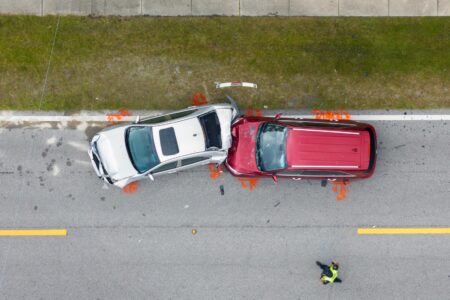

Picture this. You’re pulling into a parking spot behind a restaurant near the Crossroads, and the lot entrance isn’t clearly marked. You roll forward across what looks like a wide apron — and your tires pass over a stretch of concrete that turns out to be a public sidewalk. Takes two seconds. Nobody’s on it. You park, go inside, forget it happened.
Except an officer nearby didn’t forget.
Or maybe the scenario is different. Traffic is backed up on a surface street near Westport, and a driver ahead of you cuts across the sidewalk to access a parking lot entrance rather than waiting for the queue to move. Seems harmless. It looked clear. Saved maybe forty-five seconds.
Either way — citation. And both drivers are now holding a ticket they didn’t see coming for something they didn’t think was serious.
Why Driving Across a Sidewalk Is Taken More Seriously Than It Looks
The instinct most people have is that sidewalk crossings are minor — a technicality, maybe, or something that only matters if someone got hurt. That instinct underestimates what the law is actually protecting.
Sidewalks exist as guaranteed safe zones for people on foot. Pedestrians, kids on bikes, elderly residents, people with strollers — they use sidewalks with the assumption that vehicles stay off them. That assumption is the whole point. When a car crosses a sidewalk, even briefly, even slowly, it violates that guarantee. The law doesn’t wait for an injury to establish a violation. The intrusion itself is the problem.
Kansas City takes pedestrian safety seriously. The city has invested in crosswalk infrastructure, pedestrian signal improvements, and enforcement attention in high-foot-traffic areas — the Plaza, Westport, the Crossroads, 18th & Vine. Officers in these zones watch for exactly the kind of casual sidewalk crossings that drivers dismiss as harmless. Because the whole point of a safe zone is that it stays safe, not that it usually stays safe.
The Legal Framework — What Kansas City and Missouri Actually Prohibit
Two layers of law apply here simultaneously, and both matter.
Kansas City municipal code Section 70-405 directly prohibits operating a vehicle on a sidewalk. This is a city ordinance violation, enforced through Kansas City municipal court. The fine schedule, the court procedures, and the point application under city ordinance differ from state statute violations — which is relevant to how you respond and what outcomes are realistically available.
Missouri state law adds the second layer. RSMo § 304.015 requires vehicles to be operated on designated roadways. Sidewalks are not roadways. Operating a vehicle on one violates this statute in addition to any applicable city ordinance. Officers can cite under city code, state law, or both — and how the citation gets written shapes everything that follows in terms of points, fines, and court handling.
Here’s what this dual-layer framework means practically: a driver who crosses a sidewalk might face a single citation or multiple citations depending on how the officer characterized the incident. That characterization isn’t always fixed. It can be examined, challenged, or negotiated — but only by someone who understands how both systems work and how Kansas City courts handle the intersection of the two.
The Situations That Actually Produce These Citations in KC
Parking lot access is the single most common context. Many older commercial properties in Kansas City — particularly in neighborhoods that predate modern parking lot design standards — have entrances that require crossing public sidewalks. Drivers who access these lots the way they’ve always done it may be crossing a sidewalk every single time without realizing it constitutes a violation. When an officer is present and watching, that routine access produces a citation.
Delivery vehicles generate a specific category of sidewalk citations in dense commercial areas. A driver trying to get closer to a business entrance in the Crossroads or downtown, cutting across a sidewalk to reach a loading zone or building access point — that maneuver is a violation regardless of the vehicle type or the commercial purpose.
Traffic avoidance situations happen too. Someone stuck in a queue spots what looks like a shortcut through a parking area — except the shortcut crosses a sidewalk. The time saved is minimal. The citation is real.
Construction zone confusion creates genuine mistakes. When Kansas City road projects disrupt normal traffic patterns and create ambiguous boundaries between travel lanes and pedestrian areas, drivers sometimes cross into sidewalk territory without clear awareness. The confusion is understandable. It doesn’t constitute a legal defense, but it does factor into how prosecutors and courts approach the case.
And then there are the incidents that nobody planned. A driver distracted at a slow speed who doesn’t register where the roadway ends. A backing maneuver that goes wider than expected. A parking attempt that overshoots the space and crosses the sidewalk boundary. These are honest mistakes — but honest mistakes can still produce citations with real consequences.
Points, Fines, and the Consequences That Follow
Two to four points on a Missouri license for a sidewalk driving violation, depending on how the citation is written and which statute or ordinance applies. Against Missouri’s eight-point suspension threshold within 18 months, those points matter — especially for any driver who’s had other recent violations.
Fines vary based on the specific charge and the court handling the case. Municipal ordinance fines run on a different schedule than state statute fines. Court costs add on top. Neither the fine nor the court costs represent the largest financial exposure, though — that’s the insurance impact.
Moving violation convictions signal elevated risk to carriers. At renewal, insurance companies check driving records and adjust premiums accordingly. A sidewalk violation sits in that record as evidence of imprecise vehicle operation — and premiums respond. Twenty to thirty percent increases aren’t unusual for a moving violation conviction, and those increases persist across renewal periods.
Paying the citation immediately feels like a resolution. What it actually does is permanently close every other option. Paid means convicted. Convicted means points counted, insurance notified, record marked. There’s no revisiting it.
A Missouri traffic ticket lawyer at Speeding Ticket KC looks at these citations before any payment decision gets made. The firm handles Kansas City traffic violations under both city ordinance and state statute — they understand how these cases move through local courts, where the realistic options for reduction or dismissal live, and what the specific facts of a citation actually mean for the driver’s situation. That assessment costs nothing to get, and it consistently changes how drivers think about their next step.
When a Sidewalk Citation Escalates
Most sidewalk violations stay in traffic court. A moving violation conviction, some points, a fine — that’s the typical outcome for a crossing that happened without incident.
Several factors push cases beyond that baseline.
If a pedestrian was present on the sidewalk during the crossing — even if no contact occurred — officers can characterize the incident as something more serious than a basic lane-use violation. Reckless endangerment becomes possible when a person’s safety was directly threatened by the vehicle’s position. That’s a misdemeanor, not a traffic infraction, and carries consequences that extend well beyond a fine and points.
Property damage during a sidewalk crossing adds civil exposure alongside the traffic citation. A vehicle that struck street furniture, a mailbox, a bike rack, or any other property while crossing the sidewalk creates a separate liability issue that runs parallel to the traffic charge.
And if the driver left the scene after a sidewalk incident involving either pedestrian presence or property damage, hit-and-run implications follow. What started as a minor routing mistake becomes a significantly more complex legal situation.
Early legal review matters most when any of these escalating factors are present.
Questions Kansas City Drivers Ask About Sidewalk Citations
- What if I was just crossing the sidewalk to access a parking lot — isn’t that normal?
It’s common, but common doesn’t mean legal. Many Kansas City businesses have lot access points that cross public sidewalks, and drivers use them routinely without incident. When an officer is present, that routine access can produce a citation. The fact that others do it — or that you’ve done it dozens of times before — doesn’t create a legal exemption. What it does create is a context your attorney can present: that the crossing was brief, slow, incidental to legitimate access, and consistent with how other drivers use the same entrance.
- Does it matter whether anyone was actually on the sidewalk?
Yes — it affects severity assessment and negotiation room, but not whether the violation occurred. The law protects sidewalk space regardless of current occupancy. An empty sidewalk at the moment of crossing doesn’t eliminate the violation. What it does do is remove the most serious escalating factor — pedestrian endangerment — which gives prosecutors and courts more flexibility in how they resolve the case. An empty sidewalk supports a stronger argument for reduction to a non-moving violation.
- Can this citation be reduced to a non-moving violation?
In the right circumstances, yes. Non-moving violations carry no license points and don’t signal risk to insurance carriers. For first-time offenders in situations where the crossing was brief, unintentional, and involved no pedestrians or property damage, reductions are achievable through negotiation in Kansas City courts. Speeding Ticket KC handles these negotiations regularly and gives clients a realistic picture of what’s achievable in their specific situation — not generic optimism, but an honest read based on the actual facts.
- What if the sidewalk boundary wasn’t clearly marked at the location?
Marking clarity is a legitimate factor in building a defense. Not every sidewalk transition is obvious, particularly in older commercial areas, construction zones, or locations where road and pedestrian surfaces blend together. If the boundary between roadway and sidewalk was genuinely ambiguous at the specific location, document it immediately — photos of the site, the markings (or lack thereof), and the approach angle. That documentation gives an attorney concrete material to work with and supports an argument that the crossing wasn’t a conscious violation of a clear boundary.
- How soon after the citation do I need to act?
Sooner than most people move. Kansas City court dates arrive quickly after a citation is issued, and options narrow as response deadlines approach. Missing a deadline adds failure-to-appear consequences on top of the original violation — a completely avoidable problem. Speeding Ticket KC recommends reaching out within days of receiving any citation, not weeks. Early contact means more time to review the documentation, understand the specific charges, and pursue the best available outcome before any windows close.
Wrap Up
Driving across a sidewalk reads as trivial until the citation arrives and the consequences become visible. The points, the insurance impact, the court appearance — none of it matches the two seconds the crossing actually took. Understanding what you’re dealing with before deciding how to respond is always the better starting position.